Wednesday, June 10, 2009

The foreigner within your gates

Justin Taylor posts a short e-mail interview with James Hoffmeier, an Old Testament scholar at Trinity Evangelical Divinity School, and author of The Immigration Crisis: Immigrants, Aliens, and the Bible. Parts of the interview:
Does the OT operate with similar distinctions that we have today between documented aliens and illegal immigrants?

What I learned in my study is that there are three relevant terms used in Hebrew (ger, zar, nekhar). Different English translations render the words differently. The TNIV and NLT render them all as “foreigner.” That is misleading and incorrect.

Zar and nekhar indeed refer to foreigners or visitors, people passing through a foreign land.

Ger or the verb gwr, which together occur more than 160 times in the OT, refer to foreign residents who live in another land with the permission of a host. ....

The law is clear that ger is not to be oppressed, but to receive equal justice, and have access to the social support system of ancient Israel. And there was a provision for religious inclusion, but they were also obligated to live in accordance with the laws just like the Israelites.

The Law does not, however, extend to the zar and nekhar such benefits and services. From this I conclude that ger was viewed as a legal alien.

The mistake of some well-meaning Christians is to apply the biblical laws for the ger to illegal aliens in American even though they do not fit the biblical legal and social definition.

It seems to me that in the public square those who are using the Bible in the immigration debate assume that the Bible endorses the idea of providing sanctuary for illegal aliens. Do you agree?

The OT Law is very clear about the practice of sanctuary or accessing the cities of refuge. The former was for those living in proximity to the Tabernacle or Temple, while the city of refuge were scattered throughout Israel for easier access.

The purpose of sanctuary was not to avoid the law or one’s sentence, but to get a fair trial in the case and only in the case of accidental death (cf. Ex. 21:12-14; Num. 35:11-15, 22-29; Josh. 20:1-9).

So when American cities offer their cities as sanctuary from federal law, or when churches offer their facilities as a refuge for illegal immigrants who have been tried and ordered deported, they are neither following the letter or spirit of the OT law. .... [more]
Between Two Worlds: What Does the Bible Teach on Immigration? An Interview with James Hoffmeier

Tuesday, June 9, 2009

Slow to anger...while hating what is evil

David Powlison answers a question about whether anger is always sinful. His response in part:
  • God's anger is only good. He makes a just and justified response to true evils. At the same time, God is notably slow to anger and notably merciful (Exodus 34:6f); he does not treat us as our sins deserve (Psalm 103). But when God does express anger or warn of his anger, he expresses his goodness. “I will make my goodness pass before you and will proclaim before you my name ‘The Lord'” (Exodus 33:19). His character and name include his reckoning with evil.
  • The devil's anger is only evil. It expresses his pride, lusts, frustration, cruelty, willfulness. He is always offended, always murderous.
  • The willful, petty, entitled, irritable, argumentative, vindictive anger so typical of daily life is only evil.
  • The anger of people toward genuine wrongs is usually mixed. Anger is a just and justified response to true evils, an expression of the image of God. The fact that we see a wrong as wrong is a good thing; the fact that we care enough to be troubled is a good thing. But human beings tend to return evil for evil, expressing the image of the evil one. For example, a person can get angry for good reasons, but express the anger in many wrong ways. The mix can be tipped significantly towards either end of the spectrum. Sometimes it is barely good, quickly returning evil for evil. Sometimes it is significantly good in patiently and firmly facing down evil (though who of us is immune to the infiltration of self-righteousness?). ....
The arousal of anger is either good or bad. It may arise for good reasons: e.g., someone I trusted betrayed trust, or someone threatens to harm a child. It may arise for bad reasons: e.g., I'm stuck in a traffic jam, or someone at work had the audacity to disagree with my brilliant ideas and plans.

The motives for anger are either good or bad. Desires, beliefs, expectations, values, intentions may be good. Jesus' anger expresses faith working through love; our anger can move in his direction. Or our motives may be bad: wrong beliefs, idolatrous desires, self-pity/self-righteousness.

And, of course, as stated, the expression of anger is always either good or bad (or, again, that complication in things human, mixed). For example, anger expresses love when it energizes you to protect the helpless by opposing victimizers. And anger expresses hate when you get into petty arguments or when you bully others. .... [more]
Is Anger Morally Neutral? | CCEF

B.C.

Kevin Butler at SDB Exec Blog calls attention to the publication of I Did It His Way, a collection of Johnny Hart's religious comic strips. It is described at the Thomas Nelson site:
A side-splitting collection of comic strips from one of the most popular cartoonists in history! Legendary cartoonist, Johnny Hart, created two of the most popular comic strips in history: B.C. and Wizard of Id. When he became a Christian in 1984, Johnny turned his trademark wit and humor to matters of faith. Johnny passed away the day before Easter 2007 while at his drawing board. “This book is a dream that Johnny and I shared,” says his wife, Bobby. “I knew I had to finish our dream.”
Click here or on the illustration for access to some of the cartoons.

Seventh Day Baptist - SDB Exec Blog

One day out of seven

A couple of Facebook friends sent me looking for this about the Sabbath on YouTube:


YouTube - 1 Outta 7

Those who make the noise

DeYoung and Kluck's Why We Love the Church comes out later this month. Today Kevin DeYoung quotes from a chapter written by his co-author:
Perhaps I’m just sick of revolutionaries. I am thirty-two years old, and am a part of the generation that has probably purchased more Che Guevara posters than any other generation in history. .... We’re big on revolutionaries. We’re big on changing the world. We’re big, also, on not being ordinary.

.... The question then becomes, If we’re all revolutionaries, are any of us an actual revolutionary? Being a revolutionary used to mean that you overthrew a government; now it means that you’re a courageous enough visionary to have church on a golf course or in someone’s living room.

My point in all of this is not to make not-so-subtle jabs at revolutionary culture (maybe a little bit); rather, it is to encourage the scores of nonrevolutionaries in our midst, of which I am one. I want to encourage those of us who try really hard to pray for our families and friends, try to read our Bibles consistently, and share the gospel with those around us. Those of us who aren’t ready to chuck centuries worth of church history, and years of unglamorous but God-glorifying growth in the name of revolution. .... [more]
Two quotations from Edmund Burke:
It is undoubtedly true, though it may seem paradoxical,—but, in general, those who are habitually employed in finding and displaying faults are unqualified for the work of reformation.

Because half a dozen grasshoppers under a fern make the field ring with their importunate chink, whilst thousands of great cattle, reposing beneath the shadow of the British oak, chew the cud and are silent, pray do not imagine that those who make the noise are the only inhabitants of the field.
DeYoung, Restless, and Reformed: Perhaps I'm Just Sick of Revolutionaries

The deepest conviction of the Christian...

Elton Trueblood:
For the Christian, Christ is not the end of the quest; He is the beginning. Starting with Him, we are forced by intellectual integrity to proceed a long way. If we are committed to Him, we trust Him about the being and the character of God, about the reality of prayer, about the possibility of miracle, and about the life everlasting. The deepest conviction of the Christian is that Christ was not wrong! Particularly, we are convinced that He was not wrong in His report about Himself. It is important to remember that our commitment is to one who said, "All things have been delivered to me by my Father; and no one knows the Son except the Father, and no one knows the Father except the Son and any one to whom the Son chooses to reveal him" (Matt. 11:27).

To say that Christ is the fulcrum is not merely to say that He was the greatest figure of history or the finest moral teacher. It is, instead, to see Him as the genuine revelation of the mystery of existence, the one clear light among the many shadows. Commitment is thus vastly more than mere admiration. It means passionate involvement in His life, teachings, death, and resurrection. It is to share with Him when He says, "I am the resurrection and the life" (John 11:25). We are not Christians until we are committed, and we are not committed until we combine, in our faith in Christ, the reasons of the heart with the reasons of the intellect. Commitment to Christ does not solve our problems; on the contrary, it adds new ones. Often it brings not peace but a sword (Matt. 1o:34), because it produces a holy disturbance. In any case, it destroys what is ordinarily understood as peace of mind. Like Archimedes, we still have to do the work of lifting, but we have a solid point from which to operate. ....
Elton Trueblood, A Place to Stand, Harper & Row, 1969, pp. 39-40.

Friday, June 5, 2009

That these honored dead shall not have died in vain

I grew up in a town with many connections to the Civil War: the Milton House had been a stop on the Underground Railway and Whitford Hall at Milton College carried a plaque commemorating the students who had died in the war. As a high school student I guided tours of the museum during the Civil War Centennial and that was also when I discovered the histories written by Bruce Catton. His Centennial History of the Civil War was the first general history of that war that I owned, and soon after I acquired The American Heritage Picture History of the Civil War for which Catton wrote the narrative. John J. Miller appreciates Bruce Catton in an article from MyNorth.com:
In 1951, Doubleday published Mr. Lincoln’s Army, the first volume in what would become a trilogy about the Army of the Potomac. In the next volume, Glory Road, Catton praised “the stand-up valor of the private soldier.” His readers began to appreciate that he was doing something different from earlier Civil War historians: The heroes of his books weren’t so much the generals and men of rank who issued orders, but the grunts who did most of the actual fighting. Catton relied heavily on their thoughts and observations, drawn from regimental histories and other sources. He approached his research like a good journalist: He took careful notes, made sound judgments, and relished in the discovery of colorful quotes and details. He also embodied a kind of Midwestern nationalism that endorsed the war’s outcome but was willing to give Southerners their due. Catton, for instance, made no effort to hide his admiration of Confederate general Robert E. Lee.

.... Catton could have given lessons to professors on how history ought to be written—not in dry academic tomes full of impenetrable jargon, but in beautiful narrative prose that tells an accurate and compelling story. ....

.... A Stillness at Appomattox, the final volume in the Army of the Potomac trilogy, won the Pulitzer Prize and the National Book Award. Civil War buffs continue to recognize it as one of the finest books ever written on their favorite subject. David McCullough, the author of Truman, 1776, John Adams and other bestsellers, has described his own experience of reading it as a senior at Yale: “I think it changed my life. I didn’t know that then, naturally. All I knew was that I had found in that book a kind of splendor I had not experienced before, and it started me on a new path.” .... [more]
Michigan Author Bruce Catton Captured the Civil War

Thursday, June 4, 2009

Ten righteous men

This morning Cranach refers me to some reflections about Christianity and the Nazis. It is widely believed that the Nazi genocide of the Jews was a result of Christian anti-Semitism. There is no doubt that religious anti-Semitism prepared the way, and that many of those who engaged in and collaborated with the Holocaust were influenced by that perversion of Christian doctrine. But just as important, and for the Nazi ideologues much more important, was an anti-Christian paganism combined with pseudo-scientific ideas about race, resulting not only in the persecution and murder of those "races" considered inferior or evil, but also those "Aryans" who were "useless" — the handicapped, insane, or mentally retarded. At the center of of the Nazi racial project were the SS, commanded by Heinrich Himmler. Uwe Siemon-Netto:
“There’s no doubt about Himmler’s anticommunism and anti-Semitism; he wiped out both groups mercilessly,” writes historian Peter Longerich, “but basically he was much more engrossed with Christianity. The conflict with the Christian world, in which he grew up, was of truly existential significance to him.”

According to Longerich, Himmler considered it his life’s calling to coalesce the fight against Christians with his idea of resurrecting the lost world of (pagan) Germania. While anti-Semitism and anticommunism were core elements of Hitler’s entire National Socialist movement, de-Christianization linked to re-Germanization “was the quintessential task of the SS in Himmler’s mind,” Longerich writes in his 1,000-word tome (Longerich, Peter. Heinrich Himmler, Biographie. Munich: Siedler Verlag, 2008; 275).

.... Himmler saw Christianity as an “alien, Asiatic” imposition on the Germanic world. ....

Himmler too loathed the Christian virtue of neighborly love, Longerich reports: “The principle of Christian compassion stands in the way of his (Himmler’s) insistence on an uncompromising treatment of ‘sub-humans.’” Himmler strove to “replace Christian principles with Germanic virtues, such as toughness, as a precondition to persevere in the struggle against sub-humans and win the future.” He added, “We live in the era of the ultimate showdown with Christianity” (280).
These observations were inspired by Siemon-Netto's recent viewing of Valkyrie, the Tom Cruise film about the July 20 Plot led by Claus von Stauffenberg. I too recently watched it for the first time on DVD. Since I was a teenager I've read everything I could find about the German Resistance to Hitler and the Nazis, hoping to find something redemptive about that period of German history. The film tells one of those stories — the plot that came closest to success. Siemon-Netto notes that several of the conspirators were motivated by their faith and an unwillingness to tolerate the crimes of the regime:
“It was in reaction to reports about the mass murder of Jews…that Stauffenberg first mentioned the need for Hitler’s overthrow, that was in April of 1942,” historian Peter Hoffmann of McGill University in Montreal told Frankfurter Allgemeine Zeitung; at about the same time, Gen. Henning von Tresckow argued that unless the military killed Hitler, “we ourselves will become accomplices” (in the murder of the Jews). Hoffmann, the premier specialist on the German Resistance, counseled Valkyrie scriptwriters McQuarrie and Nathan Alexander free of charge. ....

“Most of the men involved in the 1944 plot were committed Christians,” Smith College historian Klemens von Klemperer, another leading expert on the German resistance, told this writer more than two decades ago. Some were ardent Roman Catholics like Stauffenberg, others Protestants like Carl Goerdeler, whose self-proclaimed motto was omnia restaurare in Christo (restoring everything in Christ).

...Bryan Singer managed [to] drive home one significant point made by one of the plotters early in his film. In the book of Genesis, God promised to spare Sodom if ten righteous men were to be found in that depraved place (Genesis 1:32). Sodom could not come up with those ten righteous men; Germany did. This, to Singer’s credit, ... Valkyrie has made abundantly clear. ....
Update 6/5: In a short review of Richard J. Evans' The Third Reich at War, Albert Mohler provides this quotation about Hitler's attitude toward Christianity:
Hitler’s hostility to Christianity reached new heights, or depths, during the war. It was a frequent theme of his mealtime monologues. After the war was over and victory assured, he said in 1942, the Concordat he had signed with the Catholic Church in 1933 would be formally abrogated and the Church would be dealt with like any other non-Nazi voluntary association. The Third Reich ‘would not tolerate the intervention of any foreign influence’ such as the Pope, and the Papal Nuncio would eventually have to go back to Rome. Priests, he said, were ‘black bugs’, ‘abortions in cassocks’. Hitler emphasized again and again his belief that Nazism was a secular ideology founded on modern science. Science, he declared, would easily destroy the last remaining vestiges of superstition. ‘Put a small telescope in a village, and you destroy a world of superstitions.’ ‘The best thing,’ he declared on 14 October 1941, ‘is to let Christianity die a natural death. A slow death has something comforting about it. The dogma of Christianity gets worn away before the advances of science.’ He was particularly critical of what he saw as its violation of the law of natural selection and the survival of the fittest. ‘Taken to its logical extreme, Christianity would mean the systematic cultivation of human failure.’ It was indelibly Jewish in origin and character. ‘Christianity is a prototype of Bolshevism: the mobilization by the Jew of the masses of slaves with the object of undermining society.’ Christianity was a drug, a kind of sickness: ‘Let’s be the only people who are immunized against the disease.’ ‘In the long run,’ he concluded, ‘National Socialism and religion will no longer be able to exist together.’ He would not persecute the Churches: they would simply wither away. ‘But in that case we must not replace the Church by something equivalent. That would be terrifying!’ The future was Nazi, and the future would be secular.
The Center for Lutheran Theology and Public Life: Christian Charity, the Nazis’ Final Foe, Completely Portable Pleasure -- The Annual Summer Reading List

Wednesday, June 3, 2009

Speaking as an ex-fetus

George Jonas isn't necessarily against killing — but he wishes those who call themselves "pro-choice" would acknowledge what the choice of abortion really amounts to. "Thoughts from an ex-fetus":
.... As I've written before, I'm not necessarily opposed to abortion, but then I'm not necessarily opposed to killing. I could even be persuaded that we should let mother be the arbiter of when to kill a child. King Solomon thought so, no doubt because he laboured under the illusion that an authentic mother would rather give up her child than kill it. As we now know, the good king might have been a trifle too optimistic. ....

.... I don't particularly mind abortion on demand; I mind only the arguments used to support it.

My quarrel is with those who would oppose abortion if they thought it amounted to killing. I've no problem with abortion, but they do. They've a whacking big problem. First (as I repeated ad nauseam over the years) they must pretend not to know when life begins. They must pretend not to realize that life is an autonomous process, a continuum from zygote to old-age pension, a self-elaborating force that begins when it begins and keeps growing unless it's vacuumed out first. They must pretend not to recognize something that a cat recognizes: the difference between things alive or dead, animate or inanimate. They must pretend not to see that if a fetus were not alive, it wouldn't have to be killed.

They must cling to the illusion that a court can actually choose for life to "begin" at some arbitrary point: first trimester, second trimester, whatever. I think legal fiction should adopt the notion that life begins at 40 for the comfort of those who cherish their convenience but have no stomach for killing.

Some put the question in terms of a woman's right to control her own body. That would be valid enough in the realm of smoking, diet, liposuction or sex — but abortion? Abortion means controlling someone else's body. Incidentally, I realize that as a man I have no authority to speak on the matter, but I'm not speaking as a man. I wouldn't dare. I'm speaking strictly as an ex-fetus. .... (more)
Thoughts from an ex-fetus

Temperance

In an article primarily about the abuse of alcohol, Roger Scruton observes "the ease with which puritan outrage can be displaced from one topic to another and the equal ease with which the thing formerly disapproved of can be overnight exonerated from all taint of sin." In contrast to this moral absolutism he commends the recovery of the virtue of temperance, of "feeling the right desire towards the right object and on the right occasion."
.... This puritan legacy can be seen in many aspects of British and American society. .... This has been particularly evident in the case of sex. ....

The old idea of chastity as a form of temperance eluded them. Yet what Aristotle said about anger (by way of elucidating the virtue of praotes or "gentleness") applies equally to sex. For Aristotle it is not right to avoid anger absolutely. It is necessary rather to acquire the right habit — in other words, to school oneself into feeling the right amount of anger towards the right person, on the right occasion and for the right length of time.

In just such a way we should define sexual temperance, not as the avoidance of desire, but as the habit of feeling the right desire towards the right object and on the right occasion. That is what true chastity consists in, and it provides one of the deep arguments in favour of marriage or, at least, in favour of the constraint upon sexual appetite that is offered by love, that it makes sexual enjoyment into a personally fulfilling habit. ....

When sexual taboos were lifted, therefore, they found no further reason to refrain from indulgence. Since no virtue was at risk in our sexual transgressions, these ceased overnight to be transgressions. Thereafter, no proof of the damage done to children by premature experiment, no proof of the moral and medical chaos of uninhibited sexuality, could be heard. Puritanism turned an absolute no into an absolute yes. And it looked around for other pleasures that it could forbid, not because God was offended by them but because they offended the thing that had replaced God in the Puritan conscience — namely the Self. Any pleasure harmful to the self must now be subject to the same absolute condemnation as had been directed against the pleasures of sex. Hence the hysterical campaign against smoking, which has not taken the form of advising against something harmful, but the far more alarming form of condemning that thing as a sin. You can portray young people on the screen as engaging in sexual orgies, beating each other up, swearing and exhibiting every kind of nastiness. But you must never show a young person with a cigarette in his hand, since that will be condoning and encouraging sin. Portraits of famous smokers like Brunel, Churchill and Sartre have been doctored by the Ministry of Truth in order to remove the offensive item from between their fingers, and side by side with the poster on the school notice board that advises 12-year-olds on safe sex and free abortion, is the absolutist edict saying that thou shalt not smoke. .... (more)
And on moral busybodies, the "puritans" of Scruton's essay, C.S. Lewis:
Of all tyrannies, a tyranny exercised for the good of its victims may be the most oppressive. It may be better to live under robber barons than under omnipotent moral busybodies. The robber baron’s cruelty may sometimes sleep, his cupidity may at some point be satiated; but those who torment us for our own good will torment us without end, for they do so with the approval of their own conscience.
In Vino Veritas: I'll Drink to That | Standpoint.Online

"Fifteen men on the dead man's chest..."

Some of the best ever adventure stories for boys were written by Robert Louis Stevenson — Treasure Island and Kidnapped. My father owned a soft-covered, leather-bound Works of Robert Louis Stevenson in One Volume that contained those books as well as Dr. Jekyll and Mr. Hyde, The Master of Ballantrae, A Child's Garden of Verses, and all the rest. I discovered it at an early age. Before I was in the third grade I had read Treasure Island so often that I could recite the first paragraphs from memory:
SQUIRE TRELAWNEY, Dr. Livesey, and the rest of these gentlemen having asked me to write down the whole particulars about Treasure Island, from the beginning to the end, keeping nothing back but the bearings of the island, and that only because there is still treasure not yet lifted, I take up my pen in the year of grace 17__ and go back to the time when my father kept the Admiral Benbow inn and the brown old seaman with the sabre cut first took up his lodging under our roof.

I remember him as if it were yesterday, as he came plodding to the inn door, his sea-chest following behind him in a hand-barrow—a tall, strong, heavy, nut-brown man, his tarry pigtail falling over the shoulder of his soiled blue coat, his hands ragged and scarred, with black, broken nails, and the sabre cut across one cheek, a dirty, livid white. I remember him looking round the cove and whistling to himself as he did so, and then breaking out in that old sea-song that he sang so often afterwards:

"Fifteen men on the dead man's chest—Yo-ho-ho, and a bottle of rum!" (more)
Jim Hawkins, Bill Bones, Blind Pew, Long John Silver, Israel Hands, mutiny, pirates, treasure — what could possibly be better? And it holds my attention still today, right through to the final paragraph:
The bar silver and the arms still lie, for all that I know, where Flint buried them; and certainly they shall lie there for me. Oxen and wain-ropes would not bring me back again to that accursed island; and the worst dreams that ever I have are when I hear the surf booming about its coasts or start upright in bed with the sharp voice of Captain Flint still ringing in my ears: "Pieces of eight! Pieces of eight!"
Like all the best books written for children, it can be read with even more pleasure by an adult. Read it, if you haven't — and if you can read it aloud to someone about eight, so much the better.

There have been several film versions of the story, but none of them do the book justice. The best starred Charlton Heston as Silver — but the story begs to be done again — faithfully — and with the resources and talent to do it really well.

Treasure Island by Robert Louis Stevenson

Tuesday, June 2, 2009

"I'm shocked! Shocked to find out that gambling is going on here!"

Two quotations about human nature:

J.V. Langmead Casserley:
.... It is indeed an odd paradox if a man says he believes in the Fall of man yet is shocked at anything human. Let us leave it to the romantic humanists to be shocked at these revelations. Being shocked at this kind of thing is no part of our game, so to speak.

It is strange that so many people who proclaim that they accept the orthodox belief in original sin are so little aware of the meaning and implications of their own theology that they are continually surprised and scandalized by the spectacle of the visible sins of their neighbors. After all, the visible sins are no more than the outward manifestation of the underlying sinfulness, and the orthodox Christian should not be particular shocked or surprised by their evidence.

Similarly, as we come to know more about the sins and sinfulness concealed in the lower depths of the human mind, the Christian should accept this new knowledge as a further confirmation of his own theological beliefs, neither surprising nor shocking, but precisely what his theology should lead him to expect. The laconic President Coolidge's Baptist preacher was described as being against sin. But more profoundly understood, however, the essentially Christian attitude is against sinfulness rather than against sin, against the underlying causal malady rather than against outward consequences and symptoms, and in no circumstances whatsoever against the sinner.
Dorothy L. Sayers:
A young and intelligent priest remarked to me the other day that he thought one of the greatest sources of strength in Christianity today lay in the profoundly pessimistic view it took of human nature. There is a great deal in what he says. The people who are most discouraged and made despondent by the barbarity and stupidity of human behaviour at this time are those who think highly of Homo Sapiens as a product of evolution, and who still cling to an optimistic belief in the civilizing influence of progress and enlightenment. To them, the appalling outburst of bestial ferocity in the Totalitarian States, and the obstinate selfishness and stupid greed of Capitalist Society, are not merely shocking and alarming. For them, these things are the utter negation of everything in which they have believed. It is as though the bottom had dropped out of their universe. The whole thing looks like a denial of all reason, and they feel as if they and the world had gone mad together. Now for the Christian, this is not so. He is as deeply shocked and grieved as anybody else, but he is not astonished. He has never thought very highly of human nature left to itself. He has been accustomed to the idea that there is a deep interior dislocation in the very center of human personality, and that you can never, as they say, "make people good by Act of Parliament," just because laws are man-made and therefore partake of the imperfect and self-contradictory nature of man. Humanly speaking, it is not true at all that "truly to know the good is to do the good"; it is far truer to say with St. Paul that "the evil that I would not, that I do"; so that the mere increase of knowledge is of very little help in the struggle to outlaw evil. The delusion of the mechanical perfectibility of mankind through a combined process of scientific knowledge and unconscious evolution has been responsible for a great deal of heartbreak. It is, at bottom, far more pessimistic than Christian pessimism, because, if science and progress break down, there is nothing to fall back upon. Humanism is self-contained—it provides for man no resources outside himself. The Christian dogma of the double nature in man—which asserts that man is disintegrated and necessarily imperfect in himself and all his works, yet closely related by a real unity of substance with an eternal perfection within and beyond him—makes the present parlous state of human society seem both less hopeless and less irrational.
J.V. Langmead Casserley: Graceful Reason, New York, 1954; Dorothy L. Sayers, Creed or Chaos, New York, 1949, both quoted in Affirmations of God and Man, edited by Edmund Fuller, New York, 1967.

Singing and making melody with your heart


This is another children's sermon delivered by my great-uncle, A.J.C. Bond, while he was pastor of the Plainfield, NJ, Seventh Day Baptist church in the 1920s during Prohibition to which he makes reference. It was published in a collection, When I Was A Boy, in 1928. Part of my interest, of course, is very personal — he makes reference to relatives of whom I was told but never had the opportunity to meet.

Speaking to Yourselves in Song
Speaking one to another [or to yourselves] in psalms and hymns and spiritual songs, singing and making melody with your heart to the Lord.—Ephesians 5:19.

YOU have heard me tell about my uncle who used to lead the singing in the little church where I grew up. He not only led the music in the church, but he got the whole community interested in singing. I remember one time when church choirs from other communities came to our little church and had an all day sing. And it was my Uncle John Hevener who brought them together.

Well, this same uncle was my Sabbath school teacher, and he was talking to us one Sabbath day about music and what a blessing it is. He said he was not afraid to meet any man in the road who was whistling.

Those were the days of the saloon, and there was a saloon in the village of Roanoke. A saloon was a place where they used to sell whiskey just as people do groceries. There were some lonely places between our home and the village, and I used to be afraid I would meet a drunken man. That was the only thing I was afraid of when I had to go to the store. Sometimes men would be glum and sour, and they were really dangerous. But if a man was whistling, it was a pretty good sign that he was in a good humor, and one need not be afraid of him. When one rides along a lonely road whistling or humming, he must be speaking to himself, making melody in his heart.

I can remember how my father used to whistle when at his work. He used to make boots, and it gave me a "comfy" feeling when playing about the shop to hear him softly whistling. He, didn't exactly whistle out loud. His whistling was to regular whistling what humming is to singing.

Then my mother used to hum while about her work, too. And often she would sing. That, too, gave me a good feeling, for then I knew all was going well, and mother was happy.

I remember one night when mother woke me up, way in the night, singing. That was not because she was happy, but it was because she was good and brave and because my brother, her eldest son who was dying, asked her to sing. We all got up pretty soon, and before the morning dawned my brother had gone away and left us. I am sure mother's song helped him as he entered the spirit world. I have often thought since how clear mother's voice sounded and how brave she was to sing when Lloyd asked her to, and how much love was in her song.

In our text we are asked to speak one with another in psalms and hymns and spiritual songs. How much cheer we can bring to other lives by our singing. The text seems also to say, "Speak to yourselves in psalms and hymns and spiritual songs, singing and making melody with your heart to the Lord." Our hymns and songs will be most helpful to others if we can sing with our hearts. Some of us can not sing with our voices, but all can sing with our hearts.

I know a good man who never sings with his voice. I never heard him try it. But he always has the hymn book open when others sing, and I am sure is making melody in his heart. When opportunity has been given I have heard him select a hymn; and when others have sung it I know he was singing it in his heart.

I know another man who has a singing heart but who can not sing with his voice. He got some hymns on Victrola records, and of an evening he will put one of these hymns on the Victrola and will follow not only the words but the tones. I believe that is the nearest he ever comes to singing with his voice. But oh, how he sings in his heart! I love to be with him and enjoy the melody of his happy heart and the joy of his wholesome life.

You can sing both with your hearts and voices. Cultivate the music of your hearts, that is, be pure and good and kind, and then when you sing with your voices you will be able to make others happy and to make them want to be helpful and good.
Rev. Ahva J.C. Bond, When I Was A Boy, American Sabbath Tract Society, Plainfield, NJ, 1928, pp. 79-81.

A ceremony in church is not necessarily a church ceremony

Santayana said that "fanaticism consists in redoubling your effort when you have forgotten your aim." Surely that characterizes much of the contemporary litigation about church/state relations. Apparently there are those whose beliefs are endangered by merely being in a room with religious symbols. The Journal Sentinel reports
A federal judge refused to order the Elmbrook School District to move its graduation ceremonies this weekend from the large church where it has been holding high school commencements for nearly a decade. ....

Americans United for Separation of Church and State filed its lawsuit against the Elmbrook district in late April, following the district's refusal to move the ceremonies to a secular site as requested by the group. The organization filed the lawsuit on behalf of nine unnamed current and former students, parents and taxpayers in the district.

School officials and their attorneys defended their choice of Elmbrook Church as the site of graduation ceremonies for Brookfield Central and East high schools, saying the church's 3,200-person capacity facility was chosen for its convenience and comfort. Ceremonies are secular, despite the presence of Christian iconography, including a large cross that hovers over the dais where graduates receive their diplomas, they argued. ....

"A ceremony in the church does not necessarily constitute a church ceremony," Clevert said from the bench.
Judge allows Elmbrook graduation ceremony in church - JSOnline

Monday, June 1, 2009

Murder is murder

This weekend an unhinged anarchist murdered one of the most notorious abortionists in America, thus doing the pro-life movement incalculable damage. This killing cannot be justified. Albert Mohler gets it right, using a good historical analogy:
.... In October of 1859, John Brown led a violent attack upon the United States Arsenal at Harpers Ferry, Virginia. A radical abolitionist, Brown had already proved himself capable of violence for his cause. In 1856 he had led a gang that brutally killed several pro-slavery figures in Kansas. The raid on Harpers Ferry led to more deaths before Brown and his surviving rebels were arrested, charged with treason, and executed.
When John Brown was arrested, Henry David Thoreau defended the man and his violence, asking: "Is it not possible that an individual may be right and a government wrong? Are laws to be enforced simply because they were made? Or declared by any number of men to be good, if they are not good?"

Those are the very questions some are tempted to ask now, but these weighty questions cannot justify violence in the name of an honorable cause. Thoreau was right about the fact that the laws allowing slavery in the United States were immoral and unjustifiable. John Brown was right when he claimed that slavery was a blight upon the nation's conscience — a wrong that had to be ended. Brown's logic led him to treason, and he was found guilty in a court of law and punished. Thoreau would refer to Brown as an "angel of light," but Thoreau never had to live with the consequences of his own attempt to justify murder, nor did he ever acknowledge the true character of the man.

The pro-life movement in America must not wage war against abortion by following the example of John Brown. Nor can we allow ourselves the luxury of the logic of defending the indefensible along the lines of Thoreau. We must confront this great evil of abortion from a higher plane, and know that the battle is ultimately in God's hands.

Murder is murder. The law rightly affirms that the killing of Dr. George Tiller is murder. In this we must agree. We cannot rest until the law also recognizes the killing of the unborn as murder. The killing of Dr. George Tiller makes that challenge all the more difficult. [more]
Robert George at NRO:
Whoever murdered George Tiller has done a gravely wicked thing. The evil of this action is in no way diminished by the blood George Tiller had on his own hands. No private individual had the right to execute judgment against him. We are a nation of laws. Lawless violence breeds only more lawless violence. Rightly or wrongly, George Tiller was acquitted by a jury of his peers. "Vengeance is mine, says the Lord." For the sake of justice and right, the perpetrator of this evil deed must be prosecuted, convicted, and punished. By word and deed, let us teach that violence against abortionists is not the answer to the violence of abortion. Every human life is precious. George Tiller's life was precious. We do not teach the wrongness of taking human life by wrongfully taking a human life. Let our "weapons" in the fight to defend the lives of abortion's tiny victims, be chaste weapons of the spirit.
On Faith: A Wicked Deed in Wichita - A Test for the Pro-Life Movement - R. Albert Mohler Jr., Gravely Wicked - Robert P. George - The Corner on National Review Online

Friday, May 29, 2009

The social and political benefits of religion

Caspar Melville of the New Humanist, which describes itself as "The magazine for free thinkers," interviews John Micklethwait and Adrian Wooldridge, authors of God Is Back: How the Global Revival of Faith Is Changing the World. Religion, they argue, can be dangerous, but its opponents ignore the positive good it does, especially in the American model that separates religion and the state and protects religious liberty:
.... Modernity doesn't usher in secularisation, it actively promotes religious pluralism. They then train their sights on the equally popular notion that religion contaminates all those who subscribe to its bogus myths and stories. Not true, argue Micklethwait and Wooldridge. Religion brings out both the best and worst in man, and secularists need to come to terms with the positive role religions have played in providing meaningful care and support for the oppressed as well as in the nurturing of aspirations for political freedom from Poland to Burma to El Salvador. Secularists should therefore recognise the corollary of these two facts. While it is perfectly appropriate to demand that religionists should accept the separation of church and mosque from state as a guarantee of freedom of conscience for all, secularists should play their part by accepting that religion is here to stay.

Consider the United States. It is both the most modern and one of the most religious countries in the world. It also provides solid evidence of how religions can provide a commendable array of social services in the absence of an effective welfare state. But it is also a perfect example of how religion can be kept separate from the state. If we could all become more like America, the book argues, we could all get along famously. ....

Wooldridge took up the question of what we can learn from American religious pluralism: "European secularists assume that the church is on the side of the ancien régime, of the establishment, that it's against reason and democracy and liberal emancipation, and there is a lot of evidence for that in Europe. But in America the evangelical movement advanced alongside democracy and liberal enlightened values. They were not oppositional forces but comrades in arms. If you give people more freedom and more democracy they will talk about what they want to talk about and obviously for many people that is God. Religion itself has also been important for advancing democracy - it's an example of the little platoons of civil society. Churches nurture certain civic values, that's why the Chinese government, and all totalitarian governments, have been very suspicious of them and have tried to crush them."

Micklethwait was quick to provide reinforcement. "In Eastern Europe religion has served as a battering ram for opening up the post-communist world because it serves as a focus for discontent. In Poland or Latin America even the Catholic Church has been a focus for dissent. The church can act as a barrier to democratisation, as the Catholic Church did for a long time in Europe, but it can also inspire democratisation." ....

Adrian Wooldridge: "If you look at the world of social services, religion provides two things very well. One is you have people who are willing to make sacrifices and do things that it is hard to believe that secular-minded people would do. People like Pastor Richard Smith from the Faith Assembly of God in Philadelphia, who would just walk into crack houses where people were pointing guns at him and try and close them down. No rational person, let alone any social services bureaucrat, would do that sort of thing. He was absolutely convinced that God would protect him. He devoted his entire time to helping the poor, the homeless, drug-addicted people, with very few resources. His story is remarkable but I think it is multiplied in a lot of different places. If you took away the work that is done by the church in Philadelphia alone it would represent about half a billion dollars of social services cost a year."

But wasn't there some traditional Economist bias against the welfare state here? Weren't the churches in the US merely compensating for the fact that US welfare is so threadbare? Wouldn't it be preferable if such care was provided by the state and not delivered in the context of faith? Wooldridge, the atheist, was having none of that. "Care is actually better if it is provided in a faith context. If you look at social services you have to fill in forms, people are antagonistic or they do it because they have to, whereas if you go to church for help you know you are talking to another human being who actually cares. Its not just in the US - the same is true in China or Russia and part of the Middle East. If you look around the world you have weak welfare states that don't provide, and it is unlikely that they will provide in the future. Most people who become welfare-dependent do so because of lack of skills, lack of opportunities, but also because of a lack of self-worth or a lack of a sense of meaning or purpose. These are things that religion is very good at, that bureaucratic welfare systems can't do. So yes, I think they are a good in themselves."

Though the tone at times tends toward the celebratory, the authors recognise the catastrophic damage religion can do too. "We disagree with European secularists in the idea that God is dead or unimportant, or that modernity and religion are incompatible," says Wooldridge. "Where we strongly agree with them is with the idea that religion can be dangerous, and we think that this happens when you get a fusion between political power and religion". And they think they've found the solution. "The lesson other countries should learn from America," Wooldridge continues, "is that the separation between church and state is the basis for a flourishing civil society.".... [more]
Thanks to Arts & Letters Daily for the reference.

Free market faith | New Humanist

May 29, 2009

Got up early on my birthday and walked. This is a view of Lake Monona, Madison, Wisconsin, early on this May morning.

Thursday, May 28, 2009

Good intentions and unintended consequences

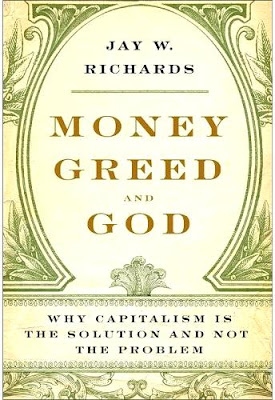
Kevin DeYoung has posted a good, informative, e-mail interview with Jay Richards, author of Money, Greed, and God: Why Capitalism Is the Solution and Not the Problem. The whole interview is worth reading and so, no doubt, is the book. What the author calls "myths" are each pretty common beliefs and deserve debunking. Two of the questions DeYoung asked and Richards' answers:
In your book, you unpack eight mistakes Christians make with economics. I don't want to make you rewrite the whole book for this interview, but could you give a one sentence description of each myth?

Here's how I summarize the eight myths in my book:
  • The nirvana myth (contrasting capitalism with an unrealizable ideal rather than with its live alternatives)
  • The piety myth (focusing on our good intentions rather than the unintended consequences of our actions)
  • The zero-sum game myth (believing that trade requires a winner and a loser)
  • The materialist myth (believing that wealth isn’t created, it’s simply transferred)
  • The greed myth (believing that the essence of capitalism is greed)
  • The usury myth (believing that charging interest on money is always exploitative)
  • The artsy myth (confusing aesthetic judgments with economic arguments)
  • The freeze frame myth (believing that things always stay the same—for example, assuming that population trends will continue indefinitely or treating a current “natural resource” as if it will always be needed)
I linked the myths to eight corresponding questions:
  • Can’t we build a just society?
  • What does God require of us as Christians?
  • Doesn’t capitalism foster unfair competition?
  • If I become rich, won’t someone else become poor?
  • Isn’t capitalism based on greed?
  • Has Christianity ever really embraced capitalism?
  • Doesn’t capitalism lead to an ugly consumerist culture?
  • Do we take more than our fair share? That is, isn’t our modern lifestyle causing us to use up all the natural resources?
I struggled with this taxonomy for a while, but I do think the vast majority of bad thinking on economics among Christians can be placed in one of these eight categories. ....

You go out of your way to argue that the universe is divinely ordered and purposeful. What difference does this make for our approach to economics?

I think that a culture's general beliefs about the nature of reality can have significant economic consequences. For instance, if one believes that the world is orderly and designed for a purpose, one is more likely to look for, and discover, aspects of that order. Moreover, these beliefs can encourage optimism, delayed gratification and a motivation to make the world a better place. Finally, it prevents one from reducing economics to materialism. The most important truths of economics emerge from the reality of the human person. That reality requires a theological/philosophical framework that can accommodate it.

Of course, to offset utopian tendencies, these beliefs are best tempered with a healthy realization of our flaws. In the Christian worldview, original sin fulfills this function. [more]
DeYoung, Restless, and Reformed: Money, Greed, and God: An Interview with Jay Richards

The Lord is our shepherd

Our worship service this week in Madison is based on the 23rd Psalm and is divided into four sections:
  • "The Lord is my shepherd, I shall not want"
  • "He leadeth me in the paths of righteousness"
  • "I will fear no evil: for Thou art with me"
  • "I will dwell in the house of the LORD forever"
All of the hymns we will sing are paraphrases of the psalm. The 1650 Scottish Psalter version twice, once to CRIMOND, and, at the end of the service, to BROTHER JAMES' AIR. We will also use Isaac Watts' "My Shepherd Will Supply My Need." Today, coincidentally, the blogger at Conjubilant With Song celebrates the author of our fourth hymn, Sir Henry Williams Baker:
Sir Henry remained with Hymns Ancient and Modern until his death in 1877, seeing it through supplements and new editions. He had contributed his own texts, several translations of Latin hymns, and even some tunes. This original hymn, yet another paraphrase of Psalm 23, is probably his most well-known.
The God of love my Shepherd is,
Whose goodness faileth never,
I nothing lack if I am thine
And thou art mine forever.

Where streams of living water flow
My ransomed soul thou leadest,
And where the verdant pastures grow,
With food celestial feedest.

Perverse and foolish oft I strayed,
But yet in love thou sought'st me,
And on thy shoulder gently laid,
And home, rejoicing, brought'st me.

In death’s dark vale I fear no ill
With thee, dear God, beside me;
Thy rod and staff my comfort still,
Thy cross before to guide me.

Thou spread’st a table in my sight;
Thy unction grace bestoweth;
And O, what transport of delight
From thy pure chalice floweth!

And so through all the length of days
Thy goodness faileth never;
Good Shepherd, may I sing thy praise
Within thy house forever.
We will be singing the original tune, DOMINUS REGIT ME.

Wednesday, May 27, 2009

Favorite hymns

Sally Thomas at First Things notes "a call for favorite hymns" at Semicolon:
.... I thought a Top 100 Hymns Poll would be a great summer project. I might learn something and be encouraged in my own worship. You might learn some new hymns or be reminded of some oldies. We all might enjoy visiting and re-visiting the hymns of the faith together. ....

Make a list of your top ten hymns of all time.
Hymn (according to Webster): a song of praise to God,a metrical composition adapted for singing in a religious service.
For the purposes of this poll, I’m limiting the choices to Christian hymns, but the form of the song doesn’t matter. In other words, the songs on your list should be suitable for congregational singing and should be Christian. Handel’s Messiah is Christian but probably not suitable for congregational hymn singing. Anything you sing in worship service, even what are normally called choruses or gospel songs or spirituals or CCM, is fine. (Oh, English, please, or at least translated into English. Sorry, but it’s all I really speak.) .... [more rules]
Thomas described how she approached making her choices and then listed them:
My criteria for hymnodic goodness are singability (as satisfying to sing while washing the dishes or putting the children to bed as with organ, brass, and eight-part choir), poetic language (to update or inclusivize it is to un-write it), and catechetical soundness. Hymnody ought, I think, to suggest to the faithful some uniquely compelling reason or other for being in church on Sunday morning and not someplace else. Some weeks back, when I found myself singing a hymn in which the voice of Jesus is made to ask, "Do you love the 'you' inside," I think I might have shut the hymnal, sat down, and waited for help to arrive, except that I sing in the choir, and there are six of us, and we were the only people singing. ....
  1. Christ Whose Glory Fills the Skies
  2. The King of Love My Shepherd Is
  3. Glory Be to Jesus
  4. My Song Is Love Unknown
  5. Lo, He Comes With Clouds Descending
  6. Be Thou My Vision
  7. I Heard the Voice of Jesus Say
  8. Glorious Things of Thee Are Spoken
  9. Ye Holy Angels Bright
  10. Of the Father's Heart Begotten
I like her criteria [and her hymns]. Here is my list, in no particular order. I fear that I am more inclined to choose because of the words than because of the music — so singability may not always reach the standard.
  1. How Firm a Foundation
  2. God Moves in a Mysterious Way
  3. Be Thou My Vision
  4. What Wondrous Love is This?
  5. God is Love, His Mercy Brightens
  6. The Lord's My Shepherd, I'll Not Want
  7. Guide Me, O Thou Great Jehovah
  8. He Who Would Valiant Be
  9. Of the Father's Love Begotten
  10. Sometimes a Light Surprises
Today, Thomas notes that PopularHymns.com has already done a survey. Their top one hundred includes only three of my top ten.

Top 100 Hymns Survey at Semicolon, First Things - Blog: First Thoughts - Top 100 Hymns Survey