‘How long ago is it—80-odd years?” Abraham Lincoln asked the crowd that had marched to the White House to celebrate the twin Union victories in the Civil War, at Gettysburg and Vicksburg. When he stood on the portico of the executive mansion to ask that question on July 7, 1863, it had actually been 87 years “since on the Fourth of July for the first time in the history of the world a nation by its representatives, assembled and declared as a self-evident truth that ‘all men are created equal.’ ” Now, he wondered, wasn’t there something almost providential to be seen in how “a gigantic Rebellion...which is an effort to overthrow the principle that all men were created equal,” had met with two stunning defeats on that anniversary? ....“When we were the political slaves of King George, and wanted to be free, we called the maxim that ‘all men are created equal’ a self-evident truth,” Lincoln wrote in 1855. No longer. Although the Fourth of July “has not quite dwindled away,” he wrote, now it is good for nothing more than “burning fire-crackers!” As he said in 1857, what was the point of celebrating the Fourth if the Declaration was now treated as “mere rubbish—old wadding left to rot on the battlefield”?But then, in quick order, came Lincoln’s election to the presidency in November 1860, the secession of the slave states to form the Southern Confederacy, and the attack on the U.S. garrison in Fort Sumter. When Lincoln called Congress into special session in 1861 to deal with the emergency, the date he selected for its assembling was July 4. And no wonder, since the Confederacy represented a direct repudiation of everything the Fourth of July once stood for. The war, he said at the special session, “presents to the whole family of man, the question, whether a constitutional republic, or a democracy—a government of the people, by the same people—can, or cannot, maintain its territorial integrity, against its own domestic foes.”No wonder Lincoln was so jubilant in 1863 when news of the Union triumph at Gettysburg (on July 3) and the surrender of the Confederate citadel of Vicksburg (on July 4) clustered around the Fourth. The rebellion that denied “all men are created equal” had now “turned tail and run,” as Lincoln said during his July 7 speech. But the ultimate vindication of the Fourth of July would come four months later, at the dedication of the national cemetery at Gettysburg for the Union dead of the battle....From the moment of the Gettysburg Address, Lincoln made it clear that Americans trace their origin not to a race, a heritage or a religion, but to the creed enunciated on the Fourth of July—that all men are created equal, that they are endowed by their Creator with certain unalienable rights, that among these are life, liberty and the pursuit of happiness. The close of the Civil War was, in large measure, Lincoln’s victory. But it was also the victory of the Fourth of July, and that victory is with us still. (more)
Showing posts with label Lincoln. Show all posts
Showing posts with label Lincoln. Show all posts
Friday, July 3, 2026
Another Glorious Fourth


Wednesday, May 6, 2026
What did Lincoln say at Gettysburg?
Ruggles of Red Gap (1935) is available on Amazon Prime for a modest rental fee and on YouTube, also for a fee. If you've never seen it, you probably should. It stars Charles Laughton and is a comedy, but has one scene that always gets to me. I watched that scene again recently:
Thursday, February 12, 2026
Mobocratic rule
On the anniversary of his birth:
Lincoln, age 28, in 1844: from the Lyceum Address delivered in Springfield:
.... If destruction be our lot, we must ourselves be its author and finisher. As a nation of freemen, we must live through all time, or die by suicide.
I hope I am over wary; but if I am not, there is, even now, something of ill-omen, amongst us. I mean the increasing disregard for law which pervades the country; the growing disposition to substitute the wild and furious passions, in lieu of the sober judgment of Courts; and the worse than savage mobs, for the executive ministers of justice. This disposition is awfully fearful in any community; and that it now exists in ours, though grating to our feelings to admit, it would be a violation of truth, and an insult to our intelligence, to deny. Accounts of outrages committed by mobs, form the every-day news of the times. They have pervaded the country, from New England to Louisiana....
...[B]y instances of the perpetrators of such acts going unpunished, the lawless in spirit, are encouraged to become lawless in practice; and having been used to no restraint, but dread of punishment, they thus become, absolutely unrestrained.— Having ever regarded Government as their deadliest bane, they make a jubilee of the suspension of its operations; and pray for nothing so much, as its total annihilation. While, on the other hand, good men, men who love tranquility, who desire to abide by the laws, and enjoy their benefits, who would gladly spill their blood in the defense of their country; seeing their property destroyed; their families insulted, and their lives endangered; their persons injured; and seeing nothing in prospect that forebodes a change for the better; become tired of, and disgusted with, a Government that offers them no protection; and are not much averse to a change in which they imagine they have nothing to lose. Thus, then, by the operation of this mobocractic spirit, which all must admit, is now abroad in the land, the strongest bulwark of any Government, and particularly of those constituted like ours, may effectually be broken down and destroyed—I mean the attachment of the People. Whenever this effect shall be produced among us; whenever the vicious portion of population shall be permitted to gather in bands of hundreds and thousands, and burn churches, ravage and rob provision-stores, throw printing presses into rivers, shoot editors, and hang and burn obnoxious persons at pleasure, and with impunity; depend on it, this Government cannot last. By such things, the feelings of the best citizens will become more or less alienated from it; and thus it will be left without friends, or with too few, and those few too weak, to make their friendship effectual. At such a time and under such circumstances, men of sufficient talent and ambition will not be wanting to seize the opportunity, strike the blow, and overturn that fair fabric, which for the last half century, has been the fondest hope, of the lovers of freedom, throughout the world. .... (more)

Wednesday, February 12, 2025
Lincoln, on the anniversary of his birth
Today is the anniversary of the birth of Abraham Lincoln. These words from the conclusion of Lincoln's First Inaugural Address (March 4, 1861) have an obvious relevance to our times:
I am loath to close. We are not enemies, but friends. We must not be enemies. Though passion may have strained it must not break our bonds of affection. The mystic chords of memory, stretching from every battlefield, and patriot grave, to every living heart and hearthstone, all over this broad land, will yet swell the chorus of the Union, when again touched, as surely they will be, by the better angels of our nature.

Lincoln Addresses the Nation - NYTimes.com
Friday, December 27, 2024
"Mem’s of 7th day B’pt Church"
For some reason, this came to mind today. Matthew Bracewell and his wife may have been Stonefort Seventh Day Baptist Church members. Pope County is the southernmost county in Illinois, across the Ohio from Kentucky. Reposted:
Dissenting took more political courage in the days before the secret ballot. In "Abraham Lincoln and Pope County" C.A. Crisp, who has a "hobby of finding cemeteries" in Pope County in southernmost Illinois, notes reference to an 1860 voter who was distinctly in the minority — and proud of it.
"…The 1860 election records show that Abraham Lincoln received only 127 votes in Pope County, while Stephen A. Douglas, received 1,202 votes…Opposition to Lincoln’s election in 1860 was so strong that one farmer in the northwestern section of the county was assaulted physically at the polls when he showed up to vote for the 'Rail Splitter.' Matthew Bracewell lived to a ripe old age and never regretted the way he cast his vote…" Pope County History and Families, Vol. 2, page 16, ‘The Civil War in Pope County’ - submitted by Ricky T. Allen.Abraham Lincoln and Pope County | Pope County, Illinois Cemeteries
The small cemetery where Matthew Bracewell and Irenne, his wife, were buried is located almost 4 miles west of Delwood. It is in a small grove of trees surrounded by a field. On his tombstone it reads:
"Mem’s of 7th day B’pt Church" ....
Matthew’s ripe old age was 81 years 1 month and 5 days.
Wednesday, July 3, 2024
A solemn and perilous circumstance
On Independence Day in 1862 Frederick Douglass delivered an address in Himrod, New York. This is only a small selection of passages from that rather long speech:
FELLOW CITIZENS: Eighty-six years ago the fourth of July was consecrated and distinguished among all the days of the year as the birthday, of American liberty and Independence. The fathers of the Republic recommended that this day be celebrated with joy and gladness by the whole American people, to their latest posterity. Probably not one of those fathers ever dreamed that this hallowed day could possibly be made to witness the strange and portentous Events now transpiring before our eyes, and which even now cast a cloud of more than midnight blackness over the face of the whole country. We are the observers of strange and fearful transactions. ....Never was this national anniversary celebrated in circumstances more trying, more momentous, more solemn and perilous, than those by which this nation is now so strongly environed. We present to the world at this moment, the painful spectacle of a great nation, undergoing all the bitter pangs of a gigantic and bloody revolution. We are torn and rent asunder, we are desolated by large and powerful armies of our own kith and kin, converted into desperate and infuriated rebels and traitors, more savage, more fierce and brutal in their modes of warfare, than any recognized barbarians making no pretensions to civilization. ....Men have strange notions now[a]days as to the manner of showing their respect for the heroes of the past. They everywhere prefer the form to the substance, the seeming to the real. .... Nevertheless, I would not even in words do violence to the grand events, and thrilling associations, that gloriously cluster around the birth of our national Independence. There is no need of any such violence. The thought of today and the work of today, are alike linked, and interlinked with the thought and work of the past. The conflict between liberty and slavery, between civilization and barbarism, between enlightened progress and stolid indifference and inactivity is the same in all countries, in all ages, and among all peoples. Your fathers drew the sword for free and independent Government, Republican in its form, Democratic in its spirit, to be administered by officers duly elected by the free and unbought suffrages of the people; and the war of today on the part of the loyal north, the east and the west, is waged for the same grand and all commanding objects. We are only continuing the tremendous struggle, which your fathers, and my fathers began eighty-six years ago. ....FELLOW CITIZENS: let me say in conclusion. This slavery begotten and slavery sustained, and slavery animated war. has now cost this nation more than a hundred thousand lives, and more than five hundred millions of treasure. It has weighed down the national heart with sorrow and heaviness, such as no speech can portray. It has cast a doubt upon the possibility of liberty and self Government which it will require a century to remove. .... I have told you of great national Opportunities in the past; a greater [one] than any in the past is the opportunity of the present. If now we omit the duty it imposes, steel our hearts against its teachings, or shrink in cowardice from the work of today, your fathers will have fought and bled in vain to establish free Institutions, and American Republicanism will become a hissing and a by-word to a mocking earth. (the entire address)

Wednesday, June 12, 2024
Wide Awake
Has the country ever been so divided? Well, yes, several times, including the 1860 Presidential election. From this review of a recent book, Wide Awake, by Jon Grinspan:
How did Lincoln, then relatively unknown in national politics, win this critical race? Presidential candidates at the time did not ordinarily campaign for themselves. ....A youth movement known as the Wide Awakes played a huge role in promoting Lincoln’s candidacy. The Wide Awakes are often mentioned in works on Lincoln, but Mr. Grinspan, a curator of political history at the Smithsonian Institution and the author of two previous books on the history of American democracy, is the first to probe them in depth.He traces the movement to five textile clerks in Hartford, Conn., who formed a grassroots political organization in February 1860 to support the antislavery Republican Party. From this initial group, known as the Hartford Originals, the movement expanded quickly. Wide Awake clubs appeared throughout the North—as Mr. Grinspan writes, they emerged “in Bangor and Brooklyn, Cambridge and Columbus, St. Paul and San Francisco, and hundreds of cities and towns in between.” Dressed in shiny oilskin capes and carrying torches, the Wide Awakes staged “monster” parades with fireworks and music, marching and thundering forth their distinctive chant: “Hurrah! Huzzah! Hurrah! Huzzah! Hurrah! Huzzah!” ....In its early phase, Mr. Grinspan demonstrates, the Wide Awake movement opposed slavery but was not progressive on race. But the movement diversified. African-Americans became Wide Awakes, with the Ohio lawyer John Mercer Langston (later a congressman representing Virginia) and the Bostonian Lewis Hayden, a former slave, leading the way. Opponents came to view the Wide Awakes as dangerous radicals involved in a conspiracy to bring about a horrid racial reversal in America. One journalist fumed: “The chief object seems to be to give the negro the supremacy over the white man.” ....It’s unknown how large the Wide Awake movement was: Mr. Grinspan gives us a rough range of between 100,000 and half a million participants. Regardless of the numbers, the Wide Awakes generated outsize excitement wherever they appeared. Violence sometimes followed, as groups of proslavery Democrats assaulted the Republican Wide Awakes with stones and brickbats, while the Wide Awakes were summoned to the fray with the cry: “Do your duty!”When the Civil War came, many of these young men traded torches for rifles. Mr. Grinspan tells us that most of the former Wide Awakes participated in the war, including the African-American Wide Awakes of Boston. ....

Wednesday, January 3, 2024
"A house divided against itself cannot stand."
When Nikki Haley seemed not to know the cause of the American Civil War, that whole argument re-emerged. The answer to the question is simple: slavery caused the Civil War. James M. McPherson, author of Battle Cry of Freedom, explains why Civil War historians don't consider it an open question:
In the 186os, few people in either North or South would have dissented from Abraham Lincoln's statement, in his second inaugural address, that slavery "was, somehow, the cause of the war." After all, had not Jefferson Davis, a large slaveholder, justified secession in 1861 as an act of self-defense against the Lincoln administration, whose policy of excluding slavery from the territories would make "property in slaves so insecure as to be comparatively worthless ... thereby annihilating in effect property worth thousands of millions of dollars"? And had not the new vice president of the Confederate States of America, Alexander H. Stephens, said in a speech at Savannah on March 21, 1861, that slavery was "the immediate cause of the late rupture and the present revolution" of Southern independence? The old confederation known as the United States, said Stephens, had been founded on the false idea that all men are created equal. The Confederacy, by contrast, "is founded upon exactly the opposite idea; its foundations are laid, its cornerstone rests, upon the great truth that the negro is not equal to the white man; that slavery, subordination to the superior race, is his natural and moral condition. This, our new Government, is the first, in the history of the world, based on this great physical, philosophical, and moral truth." ....Slaves were the principal form of wealth in the South. The market value of the four million slaves in 1860 was close to $3 billion dollars—more than the value of land, of cotton, or of anything else in the slave states. Slave labor made it possible for the American South to grow three quarters of the world's marketed cotton, which in turn constituted more than half of all American exports in the antebellum era. But slavery was much more than an economic system. It was a means of maintaining racial control and white supremacy. The centrality of slavery to "the Southern way of life" focused the region's politics on defense of the institution. But it was not the existence of slavery that polarized the nation to the breaking point, but the issue of the expansion of slave territory. Most of the crises that threatened the bonds of union arose over this matter. The first one, in 1820, was settled by the Missouri Compromise, which balanced the admission of Missouri as a slave state with the admission of Maine as a free state and banned slavery in the rest of the Louisiana Purchase territory north of 36°30' while permitting it south of that line. Paired admission of slave and free states during the next quarter century kept their numbers equal. But the annexation of Texas as a huge new slave state—with the potential of carving out several more within its boundaries—provoked new tensions. It also provoked war with Mexico in 1846, which resulted in American acquisition of three-quarters of a million square miles of new territory in the Southwest. This opened a Pandora's box of troubles that could not be closed.
Saturday, November 11, 2023
John Ford
I have twelve films in my DVD collection directed by John Ford. Hitchcock is the only director with more. About Ford at Wikipedia:
He received six Academy Awards including a record four wins for Best Director for The Informer (1935), The Grapes of Wrath (1940), How Green Was My Valley (1941), and The Quiet Man (1952). He is renowned for Westerns such as Stagecoach (1939), My Darling Clementine (1946), Fort Apache (1948), The Searchers (1956), and The Man Who Shot Liberty Valance (1962).
I have all of those except The Informer. Others I have and enjoy include Drums Along the Mohawk (1939), Mr. Roberts (1955), Rio Grand (1950), She Wore a Yellow Ribbon (1949), and Young Mr. Lincoln (1939).
Last night on YouTube I came across an excellent TCM documentary about Ford's films with interviews of actors he directed, contemporary directors appreciating his style, Ford himself, with many excerpts from his films, narrated by Orson Welles, and written and directed by Peter Bogdanovich. If you have ever enjoyed a Ford film I think you will like this, too. It motivates me to want to revisit several of the movies. Today is Veterans' Day, maybe Mr. Roberts.
Saturday, May 6, 2023
Lincoln's faith
From Barton Swaim's review of Lincoln's God:
But Swaim also writes:.... Since his early 20s—that is, after he left home in 1831 and was no longer under his father’s care—Lincoln had committed to memory many passages of the King James Bible. Not until the trial of his presidency, though, did he begin to treat scriptural language as a source of hope and moral guidance in the way a believer would. The Civil War was going badly, Lincoln’s critics were growing more numerous and more vicious, and in February 1862 his son Willie drank contaminated water and died an excruciating death.
Now, Mr. Zeitz argues, Lincoln began to embrace a quiet but genuine form of Christian belief. Of course, this isn’t strictly knowable, inasmuch as the president, a reticent man at all times, never made any explicit attestation of faith. His widow, Mary, recalled to Herndon that “he read the Bible a good deal in 1864. He felt religious more than ever about the time he went to Gettysburg”—that is, in November 1863. The president more often accompanied his wife to church in last three years of his life.
The content of Lincoln’s late public addresses, Mr. Zeitz observes furthermore, is so richly biblical that the supposition of a newfound acknowledgment of God is impossible to ignore. “Neither before nor since,” Mr. Zeitz writes of the Second Inaugural Address, “has a United States president so openly infused a public speech with religious sentiment and phrasing.” ....

Appealing thesis aside, Lincoln’s God is not a good book. It bears the marks of haphazard research, hasty writing and sloppy editing.Barton Swaim, "Lincoln’s God Review: Abe’s Ambitious Religious Creed," Wall Street Journal, May 5, 2023.
This material is new to Mr. Zeitz, and it shows. One problem is terminological. Again and again he uses the word “mainline” to describe mid-19th century evangelical churches, but that term dates from the middle of the 20th century and typically means the opposite of evangelical. He defines a “deist” as one who believes “vaguely in a controlling influence that guided human events,” literally the opposite of what a deist is. .... [and the review notes many more similar errors]
Mr. Zeitz would have been better advised to spend another year or two on research before he began writing this book. ....
Tuesday, November 8, 2022
“Government of the people, by the people, for the people”
Allen Guelzo on Lincoln on democracy:
Allen C. Guelzo, "Lincoln’s Vision of Democracy," Wall Street Journal, Nov. 8, 2022..... The least well-examined words of the address...are its expansive triplet: “government of the people, by the people, for the people.” This wasn’t merely a rhetorical flourish. In that triplet, Lincoln lays out the three fundamental elements of democracy. The first is consent—government of the people. “According to our ancient faith,” Lincoln said in his 1854 speech objecting to the Kansas-Nebraska Act, which compromised on slavery, “the just powers of governments are derived from the consent of the governed.” That meant plainly “that no man is good enough to govern another man, without that other’s consent. I say this is the leading principle—the sheet anchor of American republicanism.”
A second distinctive feature of democracy is the people’s voice in the affairs of governing—government by the people. It matters little whether that active voice is the direct participation of individuals, as in ancient Athens, or through their representatives, as in the American Constitution. From his earliest moments in politics, Lincoln argued that government by the people—through their laws and through elections, and not by mobs with nooses and shotguns—was the only legitimate expression of democracy. “I do not deny the possibility that the people may err in an election,” he conceded in 1861. “But if they do, the true cure is in the next election.”
The third basic element of democracy is a government that serves the interests of the people—government for the people—not those of a monarch, an aristocracy or an angry and contemptuous elite. For that reason, Lincoln wrote, government served to do only those things that need “to be done, but which they can not, by individual effort, do at all, or do so well, for themselves,” such as roads and bridges, schools and asylums, the enforcement of the laws and the defense of the nation. While government isn’t “charged with the duty of redressing, or preventing, all the wrongs in the world,” he said in 1859, it does have the responsibility to keep from “planting and cultivating too many thorns in the bosom of society.” ....

Friday, October 21, 2022
A Civil War history
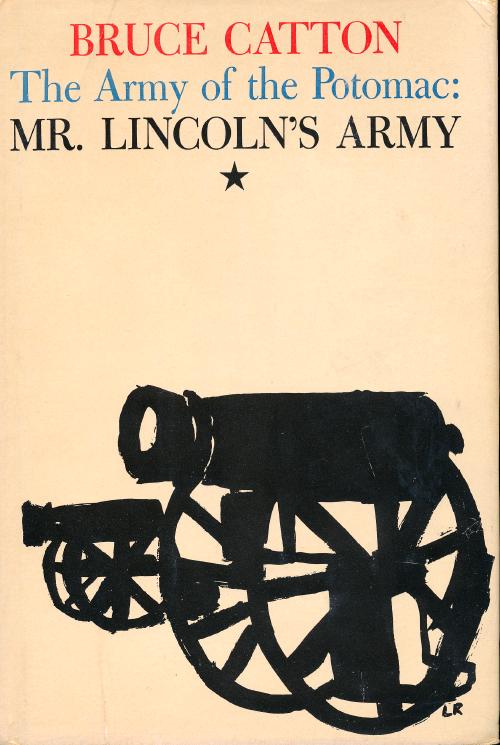
The Library of America has combined three Bruce Catton books in its The Army of the Potomac Trilogy. From Harold Holzer's "Echoes of the Battlefield" review:
Harold Holzer, "Echoes of the Battlefield," The Wall Street Journal, Oct. 21, 2022.Each volume of Catton’s Army of the Potomac trilogy appeared—and remains—a stand-alone, but together they offer a sweeping look at the war’s Eastern theater. Mr. Lincoln’s Army chronicled the origin of the first, all-volunteer Union fighting force, along with the rise and fall of its young, overcautious general, George B. McClellan. Catton reminded readers that McClellan and his commander in chief failed to click not only because their personalities clashed, but because McClellan failed to embrace Lincoln’s emancipation policy as a war goal. Catton excelled in character analysis, yet it was his breathtaking final section—a riveting account of the 1862 bloodbath at Antietam—that left 1951 readers yearning for more.
Glory Road continued the saga, taking the army through the mud of Fredericksburg, the lost opportunities of Chancellorsville and the hard-fought victory at Gettysburg, along with Lincoln’s sublime effort to consecrate the “great civil war” as “a new birth of freedom.” Finally, A Stillness at Appomattox introduced Grant into the story, tracing his slog toward Richmond during 1864 and 1865 and, ultimately, to the small Virginia town where Lee finally abandoned the struggle. It comes as little surprise that readers of the time—war buffs and literary critics alike—rejoiced in these volumes, with one reviewer hailing Stillness as “the best written and most interesting historical work about the Civil War I have ever read.” ....
The latter half of the 20th century saw an efflorescence of Civil War scholarship that later made bestsellers of the work of James M. McPherson and must-see TV of the landmark PBS series by Ken Burns. Mr. Gallagher implies, with good reason, that their roots lie in Catton’s commitments to historical accuracy and narrative verve. Modern historians may no longer cite Catton as a primary reference, but modern readers can—and should—derive much pleasure by reacquainting themselves with Catton’s brilliant technique and formidable grasp. ....
Tuesday, October 18, 2022
"To proud to pray"
President Abraham Lincoln on March 30, 1863:
Abraham Lincoln, "Proclamation Appointing a National Day of Fasting and Prayer," March 30, 1863.[W]hereas it is the duty of nations as well as of men, to own their dependence upon the overruling power of God, to confess their sins and transgressions, in humble sorrow, yet with assured hope that genuine repentance will lead to mercy and pardon; and to recognize the sublime truth, announced in the Holy Scriptures and proven by all history, that those nations only are blessed whose God is the Lord.
And, insomuch as we know that, by His divine law, nations like individuals are subjected to punishments and chastisements in this world, may we not justly fear that the awful calamity of civil war, which now desolates the land, may be but a punishment, inflicted upon us, for our presumptuous sins, to the needful end of our national reformation as a whole People? We have been the recipients of the choicest bounties of Heaven. We have been preserved, these many years, in peace and prosperity. We have grown in numbers, wealth and power, as no other nation has ever grown. But we have forgotten God. We have forgotten the gracious hand which preserved us in peace, and multiplied and enriched and strengthened us; and we have vainly imagined, in the deceitfulness of our hearts, that all these blessings were produced by some superior wisdom and virtue of our own. Intoxicated with unbroken success, we have become too self-sufficient to feel the necessity of redeeming and preserving grace, too proud to pray to the God that made us!
It behooves us then, to humble ourselves before the offended Power, to confess our national sins, and to pray for clemency and forgiveness. ....

Thursday, September 22, 2022
Cursive
A former Harvard president, now a history professor, makes a disturbing discovery:
Drew Gilpin Faust, "Gen Z Never Learned to Read Cursive," The Atlantic, Oct. 2022.It was a good book, the student told the 14 others in the undergraduate seminar I was teaching, and it included a number of excellent illustrations, such as photographs of relevant Civil War manuscripts. But, he continued, those weren’t very helpful to him, because of course he couldn’t read cursive.
Had I heard him correctly? Who else can’t read cursive? I asked the class. The answer: about two-thirds. And who can’t write it? Even more. ....
In 2010, cursive was omitted from the new national Common Core standards for K–12 education. The students in my class, and their peers, were then somewhere in elementary school. Handwriting instruction had already been declining as laptops and tablets and lessons in “keyboarding” assumed an ever more prominent place in the classroom. Most of my students remembered getting no more than a year or so of somewhat desultory cursive training, which was often pushed aside....
All of us, not just students and scholars, will be affected by cursive’s loss. The inability to read handwriting deprives society of direct access to its own past. We will become reliant on a small group of trained translators and experts to report what history—including the documents and papers of our own families—was about. The spread of literacy in the early modern West was driven by people’s desire to read God’s word for themselves, to be empowered by an experience of unmediated connection. The abandonment of cursive represents a curious reverse parallel: We are losing a connection, and thereby disempowering ourselves.
On the last day of class, a student came up to me with a copy of one of my books and asked me to sign it. I wrote an inscription that included not just his name and mine, but thanks for his many contributions to the seminar. Then I asked, a little wistfully, if he’d like me to read it to him. (more)

Monday, July 11, 2022
The greatest possible good
Nathan Schlueter asks "Is Compromise Evil?" Using positions on abolitionism before the Civil War, he argues we should avoid some approaches to compromise but that there is a correct, but difficult, kind of compromise (below I've bolded or italicised sometimes where the author did not):
...[A]lthough compromise is not likely to inspire our most heroic impulses, it is integral to political life. Like other basic human needs, it is low but necessary, and it will have its revenge on those who abuse it or treat it with contempt and refuse its humble office. That office is to achieve the greatest possible good in circumstances that are less than ideal, without sacrificing truth or integrity. The lowness of this office makes compromise an easy target for demagogues who seek to leverage their own status by sacrificing achievable goods with the intoxicating promise of impossible perfections. ....Nathan Schlueter, "Is Compromise Evil?," National Review, July 10, 2022.
We might distinguish three attitudes toward compromise. Call them Purism, Pragmatism, and Prudence. .... The Purist regards all compromise as immoral. He therefore makes the perfect the enemy of the good. In practice this often has the worst results, but for the Purist good intentions are more important than good results. ....
If Purists overestimate evil, Pragmatists underestimate it. Pragmatists are completely transactional about the good. They are willing to compromise everything in order to diffuse conflict. ....
Prudence shares Purism’s commitment to objective principles, but it always seeks ways to promote and protect those principles in imperfect circumstances. It seeks to be as shrewd as a serpent while remaining as innocent as a dove (Matt. 10:16). Prudence depends on a crucial distinction acknowledged by both Augustine and Thomas Aquinas between permitting evil and committing evil. The Pauline Principle (Rom. 3:8) states that we may never do evil to achieve good. God sometimes permits evil for the sake of greater goods, but He never commits evil. Human beings should do the same. The effort to achieve the greatest possible good without committing evil does not make one a consequentialist. It makes one prudent. .... (more)
Sunday, June 26, 2022
Lincoln on over-ruling a bad Supreme Court decision
Patrick Kurp on Lincoln and Dred Scott:
Patrick Kurp, "Read Through a Gold Eagle," Anecdotal Evidence, June 26, 2022.On June 26, 1857, in Springfield, Ill., his final resting place eight years later, Abraham Lincoln delivered a speech in reply to Stephen Douglas, who two weeks earlier had defended the U.S. Supreme Court’s Dred Scott decision. Lincoln spoke plainly, as usual, not indulging in safe generalities:That decision declares two propositions – first, that a negro cannot sue in the U.S. Courts; and secondly, that Congress cannot prohibit slavery in the Territories. It was made by a divided court – dividing differently on the different points. Judge Douglas does not discuss the merits of the decision; and, in that respect, I shall follow his example...Lincoln defers to the Constitution itself, as he often would as president, and even feigns compromise, for rhetorical effect, with Douglas:We believe, as much as Judge Douglas, (perhaps more) in obedience to, and respect for the judicial department of government. We think its decisions on Constitutional questions, when fully settled, should control, not only the particular cases decided, but the general policy of the country, subject to be disturbed only by amendment of the Constitution as provided in that instrument itself. More than this would be revolution.As always, Lincoln defends the Union. Secession, four years away, is still unthinkable – “revolution.” Preliminaries out of the way, Lincoln gets down to business:But we think the Dred Scott decision is erroneous. We know the court that made it, has often over-ruled its own decisions, and we shall do what we can to have it to over-rule this. We offer no resistance to it. (emphasis added)(more...)

Saturday, February 12, 2022
Young Lincoln
On the anniversary of his birth, an appreciation of Lincoln before he became President, "A genius for friendship.":
Scott Johnson, "A genius for friendshaip," Powerline, February 12, 2022.Lincoln is such an imposing figure that his stature obscures the man. As we view him historically, from the end of his life to the beginning of his career, he remains a figure whose greatness makes him difficult to know or understand. If we can follow him as a young man, as he finds his vocation and his calling, he may become a more familiar and accessible if no less admirable man.
In 1831 Lincoln left home at age 22 to strike out on his own in the struggling frontier town of New Salem, Illinois. He had no trade and few prospects. The single most striking fact about him as a young man is his genius for friendship. As one of his New Salem contemporaries recalled (as recorded in the interview notes of William Herndon quoted by David Herbert Donald), “Lincoln had nothing[,] only plenty of friends.” He was obviously one of the most likable men who ever lived, a man who radiated decency. Moreover, the better his acquaintances got to know him, the more they liked him. Those who got to know him best, such as the acquaintances with whom he shared boarding rooms as an impoverished young man, became lifelong friends. The student of Lincoln who can see him through the eyes of these friends will have a similar experience. .... (much more)

Wednesday, January 12, 2022
The highroad to reason
Quoted online today, Lincon in his 1842 "Temperance Address":
When the conduct of men is designed to be influenced, persuasion, kind, unassuming persuasion, should ever be adopted. It is an old and a true maxim, that a “drop of honey catches more flies than a gallon of gall.” So with men. If you would win a man to your cause, first convince him that you are his sincere friend. Therein is a drop of honey that catches his heart, which, say what he will, is the great highroad to his reason, and which, when once gained, you will find but little trouble in convincing his judgment of the justice of your cause, if indeed that cause really be a just one. On the contrary, assume to dictate to his judgment, or to command his action, or to mark him as one to be shunned and despised, and he will retreat within himself, close all the avenues to his head and his heart; and though your cause be naked truth itself, transformed to the heaviest lance, harder than steel, and sharper than steel can be made, and though you throw it with more than Herculean force and precision, you shall be no more be able to pierce him, than to penetrate the hard shell of a tortoise with a rye straw.Abraham Lincoln, "Temperance Address," 1842.
Monday, October 25, 2021
A platform for moralizing
From an interesting review of a new biography of Robert E. Lee, Robert E. Lee: A Life, by Allen C. Guelzo. The reviewer is Andrew Ferguson, someone I would read whatever his subject.
Andrew Ferguson, "A Matter of Treason," REVIEW: ‘Robert E. Lee: A Life’ by Allen C. Guelzo.... The dwindling number of die-hards who cling to the myth of the Lost Cause see slavery as contingent to the war, while the much larger number (far and away a majority) see slavery as the only reason the war was fought. Both sides avoid complication because they use history as a platform for moralizing. Robert E. Lee himself appears either as a marble saint or an ogre of staggering villainy. ....
...[F]or Guelzo, Lee’s great offense was not his invidious and (among his peers) universally held ideas about race but an actual, definable, objective crime, and the crime was treason.
Guelzo’s Lee is a man in full: genteel, cruel, loving, intolerant, generous, neither the hero of 19th and 20th century hagiographers nor the figure of unalloyed evil preferred by our contemporaries. But at the heart of the portrait here is the unforgivable crime. ....
Thus did Robert E. Lee," writes Guelzo, "irrevocably, finally, publicly [turn] his back on his service, his flag, and ultimately, his country. All of this was done for the sake of the preservation of a political regime whose acknowledged purpose was the preservation of a system of chattel slavery that he knew to be an evil and for which he felt little affection and whose constitutional basis he dismissed as a fiction…. It would, in the end, cost him nearly everything ….Guelzo’s judgment of Lee, balanced as it is, should discomfit conservatives no less than liberals, especially anyone on the right willing to gloss over Lee’s crime against our country in favor of his undoubted martial virtues or some magnolia-fragranced image of agrarian heroism. Most impressive of all, Robert E. Lee: A Life injects learning, subtlety, and even compassion into a debate that has more often been characterized by ignorance, simple-mindedness, and sanctimony. .... (more)

Thursday, March 4, 2021
"We must not be enemies"
Patrick Kurp writes about Lincoln's strengths as a writer beginning by quoting from his first inaugural address, delivered one hundred sixty years ago today:
Anecdotal Evidence: 'The Lesson of Terseness and Strength'
.... I am loath to close. We are not enemies, but friends. We must not be enemies. Though passion may have strained, it must not break our bonds of affection. The mystic chords of memory, stretching from every battle-field and patriot grave to every living heart and hearthstone all over this broad land, will yet swell the chorus of the Union when again touched, as surely they will be, by the better angels of our nature.More.
Anecdotal Evidence: 'The Lesson of Terseness and Strength'
Subscribe to:
Posts (Atom)