Showing posts with label Advent and Christmas. Show all posts

Tuesday, January 6, 2026

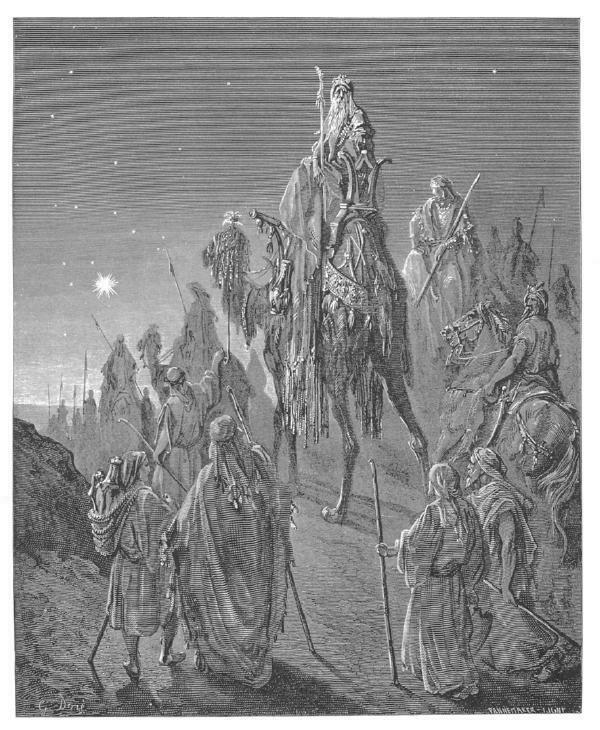
Magi

"The star, which they saw in the east, went before them..."
The term Epiphany is taken from the Greek word for “manifestation” and is a date to celebrate the incarnation of Christ. In some denominations, the day is also known as Three Kings’ Day since it commemorates the “twelfth day of Christmas,” or twelve days after Jesus’ birth, when according to tradition the magi visited Mary, Joseph, and their child. (In the Bible, neither the number of “wise men” nor the date they arrived is specified.) ....
9 Things You Should Know About the Christian Calendar

Wednesday, December 31, 2025

A New Year hymn

Found at Conjubilant With Song:
O God, whom neither time nor space
Can limit, hold, or bind.
Look down from heav'n, Thy dwelling place
With love for humankind.

Another year its course has run,
Thy loving care renew;
Forgive the ill that we have done,
The good we failed to do.

In doubt or danger, all our days,
Be near to guard us still;
Let all our thoughts and all our ways
Be guided by Thy will.

O help us here on earth to live
From selfish strife set free;
To us at last in mercy give
Eternal life with Thee.

Horace Smith, 19th cent.; alt.
Tune Scottish Psalter, 1635
Conjubilant With Song: Another Year Its Course Has Run

Tuesday, December 30, 2025

Good health to you!


Wassail, wassail, to our town,
The cup is white, the ale is brown;
The cup is made of the ashen tree,
And so is your ale of the good barley.
Little maid, little maid, turn the pin,
Open the door and let us come in.
God be here, God be there,
I wish you all a happy New Year.
Note The Wassail Cup was a wooden cup (one rhyme says "made of the rosemary tree") of spiced ale, apples and sugar, which they drank at the New Year. The word Wassail comes from the Anglo-Saxon Waes hal! be whole! — that is to say, good health to you! Children carried round a bunch of evergreens hung with apples, oranges and ribbons, called a Wessel-bob. "Turn the pin" means "unfasten the latch".

Cicely Mary Barker, The Children's Book of Rhymes

Wednesday, December 17, 2025

Remembering Christmas past

From Dickens' Pickwick Papers.
...[N]umerous indeed are the hearts to which Christmas brings a brief season of happiness and enjoyment. How many families, whose members have been dispersed and scattered far and wide, in the restless struggles of life, are then reunited, and meet once again in that happy state of companionship and mutual goodwill, which is a source of such pure and unalloyed delight; and one so incompatible with the cares and sorrows of the world, that the religious belief of the most civilised nations, and the rude traditions of the roughest savages, alike number it among the first joys of a future condition of existence, provided for the blessed and happy! How many old recollections, and how many dormant sympathies, does Christmas time awaken!

We write these words now, many miles distant from the spot at which, year after year, we met on that day, a merry and joyous circle. Many of the hearts that throbbed so gaily then, have ceased to beat; many of the looks that shone so brightly then, have ceased to glow; the hands we grasped, have grown cold; the eyes we sought, have hid their lustre in the grave; and yet the old house, the room, the merry voices and smiling faces, the jest, the laugh, the most minute and trivial circumstances connected with those happy meetings, crowd upon our mind at each recurrence of the season, as if the last assemblage had been but yesterday! Happy, happy Christmas, that can win us back to the delusions of our childish days; that can recall to the old man the pleasures of his youth; that can transport the sailor and the traveler, thousands of miles away, back to his own fireside and his quiet home! ....
Charles Dickens, The Pickwick Papers, Chapter 28.

Tuesday, December 16, 2025

If we don't believe, what is it we disbelieve?

From Dorothy L. Sayers, "The Greatest Drama Ever Staged":
.... What think ye of Christ? Before we adopt any of the unofficial solutions (some of which are indeed excessively dull)—before we dismiss Christ as a myth, an idealist, a demagogue, a liar or a lunatic—it will do no harm to find out what the creeds really say about Him. What does the Church think of Christ?

The Church's answer is categorical and uncompromising, and it is this: That Jesus Bar-Joseph, the carpenter of Nazareth, was in fact and in truth, and in the most exact and literal sense of the words, the God "by Whom all things were made." His body and brain were those of a common man; His personality was the personality of God, so far as that personality could be expressed in human terms. He was not a kind of dæmon or fairy pretending to be human; He was in every respect a genuine living man. He was not merely a man so good as to be "like God"—He was God.

Now, this is not just a pious commonplace; it is not commonplace at all. For what it means is this, among other things: that for whatever reason God chose to make man as he is—limited and suffering and subject to sorrows and death—He had the honesty and the courage to take His own medicine. Whatever game He is playing with His creation, He has kept His own rules and played fair. He can exact nothing from man that He has not exacted from Himself. He has Himself gone through the whole of human experience, from the trivial irritations of family life and the cramping restrictions of hard work and lack of money to the worst horrors of pain and humiliation, defeat, despair and death. When He was a man, He played the man. He was born in poverty and died in disgrace and thought it well worth while. ....

Now, nobody is compelled to believe a single word of this remarkable story. God (says the Church) has created us perfectly free to disbelieve in Him as much as we choose. If we do disbelieve, then He and we must take the consequences in a world ruled by cause and effect. The Church says further, that man did, in fact, disbelieve, and that God did, in fact, take the consequences. All the same, if we are going to disbelieve a thing, it seems on the whole to be desirable that we should first find out what, exactly, we are disbelieving. Very well, then: "The right Faith is, that we believe that Jesus Christ is God and Man. Perfect God and perfect Man, of a reasonable soul and human flesh subsisting. Who although He be God and Man, yet is He not two, but one Christ." There is the essential doctrine, of which the whole elaborate structure of Christian faith and morals is only the logical consequence. ....
Dorothy L. Sayers, "The Greatest Drama Ever Staged," Creed or Chaos? 1938.

Monday, December 15, 2025

"Just another Mary"

From The Wall Street Journal a few years ago:
The first person ever to hear that Jesus is the Son of God was a low-income teenage girl in an obscure backwater of the Roman empire. She went by the most common name for Jewish women of her time and place: She was just another Mary. But then she claimed an angel had appeared to her and told her she would give birth to the Son of God. From the perspective of both Jews and Romans in the first century A.D., her story was completely unbelievable. How has it lasted for 2,000 years?

Today, Mary’s claim to have met an angel is part of what makes her story hard to believe. We imagine angels like the fairy on top of the Christmas tree, only bigger, so Mary’s story feels like a fairy tale. But angels in the Bible aren’t remotely fairylike. They’re terrifying messengers from God. ....
“Do not be afraid, for you have found favor with God. And behold, you will conceive in your womb and bear a son, and you shall call his name Jesus. He will be great and will be called the Son of the Most High. And the Lord God will give him the throne of his father David, and he will reign over the house of Jacob forever, and of his kingdom there will be no end!” (Luke 1:30-33).
.... Doubtless Mary had a lot of questions for the angel, but she asked just one: “How will this be, since I’m a virgin?” Mary knew the facts of life. The title “Son of God” could technically just have meant the Messiah. Perhaps she thought that Joseph, her betrothed, would be the father of this longed-for King. But then the angel dropped another bomb:
“The Holy Spirit will come upon you, and the power of the Most High will overshadow you; therefore the child to be born will be called holy—the Son of God” (Luke 1:35).
.... But why would God become a man? Why would he live in poverty and die in agony? Why would the King of all creation come not to be served but to serve and to give his life as a ransom for many? According to the Christian story, it was because of love for every human being, rich or poor, weak or strong, enslaved or free. He paid the price for human sin—a word we may not choose to use but a reality we hit upon when we bewail injustice in this world and wonder why it seems so hard to fix. Christians believe that the Son of God was born to die, so that all who trust in him could live as sons and daughters of God—wrapped up more tightly in his love than the newborn Jesus was wrapped up by Mary in his swaddling clothes.

When Mary met the angel, she was a no-name girl from a disempowered people in a seemingly inconsequential place. Today, if you worry that you might be insignificant—unknown, unloved and unimportant in this world—perhaps this Christmas you will hear her message with fresh ears. If she was right about her son, then you are worth the birth and life and death and resurrection of the Son of God. (more)
Rebecca McLaughlin, "When Mary Met the Angel," The Wall Street Journal, Dec. 24, 2022.

Friday, December 12, 2025

St. Nick

Of all the portrayals of the modern St. Nicholas,  Santa Claus — this is my favorite. From the cover of St. Nicholas magazine, December, 1916:

Sunday, December 22, 2024

In the bleak midwinter


In the bleak midwinter, 
    frosty wind made moan,
Earth stood hard as iron,
    water like a stone;
Snow had fallen, snow on snow,
    snow on snow,
In the bleak midwinter, long ago.
Angels and archangels may
    have gathered there,
Cherubim and seraphim

    thronged the air;
But His mother only,

    in her maiden bliss,
Worshiped the beloved with a kiss.

Our God, Heaven cannot hold Him,
    nor earth sustain;
Heaven and earth shall flee away

    when He comes to reign.
In the bleak midwinter

    a stable place sufficed
The Lord God Almighty, Jesus Christ.


What can I give Him, poor as I am?
If I were a shepherd,

    I would bring a lamb;
If I were a Wise Man,

    I would do my part;
Yet what I can I give Him:

    give my heart.
Enough for Him, whom cherubim,
    worship night and day,
Breastful of milk,

    and a mangerful of hay;
Enough for Him,

    whom angels fall before,
The ox and ass and camel which adore.

 
Christina Rossetti, 1872

Saturday, December 21, 2024

The Truth sent from Above

Ralph Vaughan Williams, "Herefordshire Carol":


This is the truth sent from above,
The truth of God, the God of love;
Therefore don’t turn me from your door,   
But hearken all both rich and poor.
And at that season of the year
Our blest Redeemer did appear;
He here did live, and here did preach,
And may thousands he did teach.
The first thing which I do relate
Is that God did man create;
The next thing which to you I’ll tell
Woman was made with man to dwell.
Thus He in love to us behaved,
To show us how we must be saved;
And if you want to know the way,
Be pleased to hear what He did say.
And we were heirs to endless woes,
Till God the Lord did interpose;
And so a promise soon did run
That He would redeem us by his Son.


There are more verses, including:

"Go preach the Gospel," now He said,
"To all the nations that are made!
And he that does believe on me,
From all his sins I'll set him free."

O seek! O seek of God above
That saving faith that works by love!
And, if He's pleased to grant thee this,
Thou'rt sure to have eternal bliss.

God grant to all within this place
True saving faith, that special grace
Which to His people doth belong:
And thus I close my Christmas song.

Wednesday, December 18, 2024

More Dickens Christmas

Christmastide at 600 College St. when I was young: candles in every street-facing window, a wreath on the front door and a festooned evergreen in the front window (first real, then later, artificial), large-format Christmas Ideals on the coffee table, Christmas cards taped to the kitchen wall by Mom, and more. Records came out, too. We had a recording of A Child's Christmas in Wales read by Dylan Thomas himself. The record I remember best was a 45rpm of Lionel Barrymore as Scrooge in Dickens' Christmas Carol. He had performed that role year after year on the radio in the 40s and 50s. Listening to the record was one of our family Christmas traditions. I transferred the recording to CD years ago and just found it among my collection of Christmas music. The original record sleeve:


 And this, provided by YouTube, is the recording:

Monday, December 16, 2024

The rightful king has landed...

C.S. Lewis on the Incarnation:
  • …the Christian story is precisely the story of one grand miracle, the Christian assertion being that what is beyond all space and time, what is uncreated, eternal, came into nature, into human nature, descended into His own universe, and rose again, bringing nature up with Him. It is precisely one great miracle. If you take that away there is nothing specifically Christian left. (God in the Dock)
  • The central miracle asserted by Christians is the Incarnation. They say that God became Man. Every other miracle prepares for this, or exhibits this, or results from this. (Miracles)
  • In the Christian story God descends to reascend. He comes down;…down to the very roots and sea-bed of the Nature he has created. But He goes down to come up again and bring the whole ruined world up with Him. (Miracles)
  • The Incarnation…illuminates and orders all other phenomena, explains both our laughter and our logic, our fear of the dead and our knowledge that it is somehow good to die, and which at one stroke covers what multitudes of separate theories will hardly cover for us if this is rejected. (Miracles)
  • But supposing God became man—suppose our human nature which can suffer and die was amalgamated with God’s nature in one person—then that person could help us. He could surrender His will, and suffer and die, because He was man; and He could do it perfectly because He was God…. But we cannot share God’s dying unless God dies; and He cannot die except by being a man, That is the sense in which He pays our debt, and suffers for us what He Himself need not suffer at all. (Mere Christianity)
  • Enemy-occupied territory—that is what this world is. Christianity is the story of how the rightful king has landed, you might say landed in disguise, and is calling us all to take part in a great campaign of sabotage.” (Mere Christianity)

Sunday, December 15, 2024

"Happy, happy Christmas, that can win us back to the delusions of our childish days"

From Dickens' Pickwick Papers.
...[N]umerous indeed are the hearts to which Christmas brings a brief season of happiness and enjoyment. How many families, whose members have been dispersed and scattered far and wide, in the restless struggles of life, are then reunited, and meet once again in that happy state of companionship and mutual goodwill, which is a source of such pure and unalloyed delight; and one so incompatible with the cares and sorrows of the world, that the religious belief of the most civilised nations, and the rude traditions of the roughest savages, alike number it among the first joys of a future condition of existence, provided for the blessed and happy! How many old recollections, and how many dormant sympathies, does Christmas time awaken!

We write these words now, many miles distant from the spot at which, year after year, we met on that day, a merry and joyous circle. Many of the hearts that throbbed so gaily then, have ceased to beat; many of the looks that shone so brightly then, have ceased to glow; the hands we grasped, have grown cold; the eyes we sought, have hid their lustre in the grave; and yet the old house, the room, the merry voices and smiling faces, the jest, the laugh, the most minute and trivial circumstances connected with those happy meetings, crowd upon our mind at each recurrence of the season, as if the last assemblage had been but yesterday! Happy, happy Christmas, that can win us back to the delusions of our childish days; that can recall to the old man the pleasures of his youth; that can transport the sailor and the traveler, thousands of miles away, back to his own fireside and his quiet home! ....
Charles Dickens, The Pickwick Papers, Chapter 28.

Thursday, December 5, 2024

Someone came to find us

Advent began this past weekend. Walter Russell Mead reflected on the meaning of Advent in "The Coming":
.... If there is no Christmas, there is no Cross, no answer to the problems of sin, separation, failure and pain. Advent is a time to think about what life would be like if we didn’t have faith in a Redeemer, a Savior who was ready, willing and able to complete the broken arc of our lives, forgive what is past and walk with us step by step to help us build something better in the time that is left.

Advent is a time to remember that we need something more than what we can summon with our own resources to make our lives work. It’s a time to remember how lost we would be if Someone hadn’t come to find us. .... The preparation for Christmas begins by reflecting on what kind of world this would be, and what kind of lives we would have, if Christmas had never come.

There are worse ways to start your preparation for Christmas than by using this prayer from the old Episcopal Church Book of Common Prayer:
ALMIGHTY God, give us grace that we may cast away the works of darkness, and put upon us the armour of light, now in the time of this mortal life, in which thy Son Jesus Christ came to visit us in great humility; that in the last day, when he shall come again in his glorious majesty to judge both the quick and the dead, we may rise to the life immortal, through him who liveth and reigneth with Thee and the Holy Ghost, now and ever. Amen.

Tuesday, December 3, 2024

Pagan, or not?

I put out my Christmas wreath this weekend. I've known Christians who choose not to celebrate Christmas. Kevin DeYoung explains why at least some of the oft-cited reasons don't stand up. From "Is Christmas a Pagan Rip-off?":
We’ve heard it so many times that it’s practically part of the Christmas story itself.

The Romans celebrated their seven-day winter festival, Saturnalia, starting on December 17. It was a thoroughly pagan affair full of debauchery and the worship of the god Saturn. To mark the end of the winter solstice, the Roman emperor established December 25 as a feast to Sol Invictus (the Unconquered Sun). Wanting to make Christianity more palatable to the Romans and more popular with the people, the church co-opted these pagan festivals and put the celebration of the birth of their Savior on December 25. For whatever the Christmas holiday has become today, it started as a copycat of well-established pagan holidays. If you like Christmas, you have Saturnalia and Sol Invictus to thank.

That’s the story, and everyone from liberal Christians to conservative Christians to non-Christians seem to agree that it’s true.

Except that it isn’t. ....

...[T]here is good evidence that December 25 was not chosen because of any pagan winter holidays. This is the argument Andrew McGowan, of Yale Divinity School, makes in his article “How December 25 Became Christmas” (first published in Bible Review in 2002). Let me try to distill McGowan’s fine historical work by addressing three questions.
The three questions:
  • When did Christians first start celebrating the birth of Jesus on December 25?
  • When was it first suggested that Christmas grew out of pagan origins?
  • Why do we celebrate Christmas on December 25?

Sunday, December 1, 2024

Marcionism

An ancient heresy returns again in support of political bigotry. From The Free Press:
.... Like a boil on the backside of the body politic, there has been an ugly irruption of Jew-hating foolishness over casting in the upcoming Netflix film Mary, about the life of Jesus’s mother. People are outraged—outraged!—that director D.J. Caruso cast an Israeli Jew, Noa Cohen, to play the title character. ....

...[E]very Christian knows from the Bible that Mary was a Jewish maiden visited by the Archangel Gabriel, who told her that, though a virgin, she would conceive by the Holy Spirit and bear Israel’s long-awaited messiah.

“Behold, the handmaid of the Lord,” she replied. “Be it done unto me according to thy word.” (Luke 1:38)

The Gospel of Matthew begins with a recitation of the long lineage of Jesus, to demonstrate that the Nazarene son of Mary descended from both Abraham and King David. This is not coincidence: It is necessary to establish Jesus’s messianic credentials according to the Hebrew Bible.

Of course Jews don’t accept this, but believe that the messiah is still to come. The point is simply that it is impossible to extricate Jesus and his mother from Judaism. ....

To deny the Jewishness of Jesus is not only to negate the clear and unambiguous testimony of Scripture but to render as nonsense the entire salvation narrative.

Indeed, as Jesus himself told the Samaritan woman, God sent salvation to all of humanity through the Jewish people. No Jews, no Jesus. Though from the Christian perspective, Jews today reject the divinity of Jesus, as did their ancestors—while from the Jewish perspective they have merely remained true to their covenant with God—followers of Jesus cannot reject the Jews without being guilty of a serious, even fatal, heresy.

That heresy is a very old one, and it is called Marcionism. Marcion was a wealthy second-century Christian who, under the influence of Gnosticism, taught that the God of the New Testament was not the God of the Hebrew Bible. The Hebrew god was, according to Marcion, a god of wrath; the Christian god was a god of love. These are two distinct deities, he said, and the Christian god is sovereign. ....

Marcionism was strongly condemned by the Church fathers, who defended the legitimacy and necessity of the Hebrew scriptures. In Marcionism, Christianity replaces Judaism; in Christian orthodoxy, Christianity fulfills Judaism. “Don’t misunderstand why I have come—it isn’t to cancel the laws of Moses and the warnings of the prophets,” said Jesus (Matthew 5:17). “No, I came to fulfill them and to make them all come true.” ....

...[W]hat all authoritative Christian traditions share is an irrevocable, undeniable testimony that God chose the Jewish people to make Himself known to all of humanity, and that without Hebrew Scripture and tradition, the Christian faith would make no sense at all. .... (more)

Friday, January 5, 2024

Epiphany

"The star, which they saw in the east, went before them..."

The term Epiphany is taken from the Greek word for “manifestation” and is a date to celebrate the incarnation of Christ. In some denominations, the day is also known as Three Kings’ Day since it commemorates the “twelfth day of Christmas,” or twelve days after Jesus’ birth, when according to tradition the magi visited Mary, Joseph, and their child. (In the Bible, neither the number of “wise men” nor the date they arrived is specified.) ....
9 Things You Should Know About the Christian Calendar

Monday, January 1, 2024

"Strengthen me, O Lord, in good purposes"

Samuel Johnson, New Year's Day, 1772:
ALMIGHTY GOD, who hast permitted me to see the beginning of another year, enable me so to receive Thy mercy, as that it may raise in me stronger desires of pleasing Thee by purity of mind and holiness of Life. Strengthen me, O Lord, in good purposes, and reasonable meditations. Look with pity upon all my disorders of mind, and infirmities of body. Grant that the residue of my life may enjoy such degrees of health as may permit me to be useful, and that I may live to Thy Glory; and O merciful Lord when it shall please Thee to call me from the present state, enable me to die in confidence of Thy mercy, and receive me to everlasting happiness, for the sake of Jesus Christ our Lord. Amen.

Thursday, December 28, 2023

"Herod the king, in his raging..."

The carol mourns the death of the baby boys of Bethlehem when King Herod, having caught wind that one of them was destined to take over his job as king of the Jews, ordered their murder. The song itself was crafted for a medieval mystery play, performed annually in the city of Coventry from the late 12th century until Protestants shut down such rituals in the late 16th century. ....

...[T]he massacre of the babies of Bethlehem is commemorated each year as the Feast of the Holy Innocents. The feast is held every Christmastide on December 28 — today. The Innocents are venerated as the first Christian martyrs, for, in the words of St. Augustine, “they are the first buds of the Church killed by the frost of persecution; they died not only for Christ, but in his stead.”


Kayla Bartsch, "The Bloody Tale behind the Coventry Carol," National Review, December 28, 2023.

Saturday, December 23, 2023

"To lay aside his crown for my soul"


More:
What wondrous love is this, O my soul, O my soul!
What wondrous love is this, O my soul!
What wondrous love is this that caused the Lord of bliss
To lay aside his crown for my soul, for my soul,
To lay aside his crown for my soul.

To God and to the Lamb, I will sing, I will sing;
To God and to the Lamb, I will sing.
To God and to the Lamb who is the great I AM;
While millions join the theme, I will sing, I will sing;
While millions join the theme, I will sing.

And when from death I’m free, I’ll sing on, I’ll sing on;
And when from death I’m free, I’ll sing on.
And when from death I’m free, I’ll sing and joyful be;
And through eternity, I’ll sing on, I’ll sing on;
And through eternity, I’ll sing on.

Then friends shall meet again, who have loved, who have loved,
Then friends shall meet again, who have loved;
Then friends shall meet again, in Jesus' presence, when
We'll meet to part no more, who have loved, who have loved,
We'll meet to part no more, who have loved.

Ye winged seraphs, fly! Bear the news, bear the news.
Ye winged seraphs fly! bear the news;
Ye winged seraphs fly! Like comets through the sky,
Fill vast eternity with the news, with the news,
Fill vast eternity with the news!


Anonymous; composite; 19th cent.
Tune: WONDROUS LOVE (6.6.6.3.6.6.6.6.6.3.)
American folk tune; The Southern Harmony, 1840