Monday, January 24, 2022

"For Thy mercy's sake..."

Hide not Thou Thy face from us, O Lord,
And cast not off Thy servants in Thy displeasure;
For we confess our sins unto Thee,
And hide not our unrighteousness.
For Thy mercy's sake,
Deliver us from all our sins.
And this:


Lord, for Thy tender mercy's sake,
Lay not our sins to our charge,
But forgive that is past,
And give us grace to amend our sinful lives.
To decline from sin and incline to virtue,
That we may walk in a perfect heart before Thee,
Now and evermore.
Amen.

Saturday, January 22, 2022

A disposition

From Michael Oakeshott's essay, "On being conservative," which can be found in Rationalism in politics and other essays (1962, 1991):
.... To be conservative is to be disposed to think and behave in certain manners; it is to prefer certain kinds of conduct and certain conditions of human circumstances to others; it is to be disposed to make certain kinds of choices. And my design here is to construe this disposition as it appears in contemporary character, rather than to transpose it into the idiom of general principles.

The general characteristics of this disposition are not difficult to discern, although they have often been mistaken. They centre upon a propensity to use and to enjoy what is available rather than to wish for or to look for something else; to delight in what is present rather than what was or what may be. Reflection may bring to light an appropriate gratefulness for what is available, and consequently the acknowledgment of a gift or an inheritance from the past; but there is no mere idolizing of what is past and gone. What is esteemed is the present; and it is esteemed not on account of its connections with a remote antiquity, nor because it is recognized to be more admirable than any possible alternative, but on account of its familiarity: not, Verweile doch, du bist so schon, but, Stay with me because I am attached to you.

If the present is arid, offering little or nothing to be used or enjoyed, then this inclination will be weak or absent; if the present is remarkably unsettled, it will display itself in a search for a firmer foothold and consequently in a recourse to and an exploration of the past; but it asserts itself characteristically when there is much to be enjoyed, and it will be strongest when this is combined with evident risk of loss. In short, it is a disposition appropriate to a man who is acutely aware of having something to lose which he has learned to care for; a man in some degree rich in opportunities for enjoyment, but not so rich that he can afford to be indifferent to loss. It will appear more naturally in the old than in the young, not because the old are more sensitive to loss but because they are apt to be more fully aware of the resources of their world and therefore less likely to find them inadequate. In some people this disposition is weak merely because they are ignorant of what their world has to offer them: the present appears to them only as a residue of importunities.

To be conservative, then, is to prefer the familiar to the unknown, to prefer the tried to the untried, fact to mystery, the actual to the possible, the limited to the unbounded, the near to the distant, the sufficient to the superabundant, the convenient to the perfect, present laughter to utopian bliss. Familiar relationships and loyalties will be preferred to the allure of more profitable attachments; to acquire and to enlarge will be less important than to keep, to cultivate and to enjoy; the grief of loss will be more acute than the excitement of novelty or promise. It is to be equal to one's own fortune, to live at the level of one's own means, to be content with the want of greater perfection which belongs alike to oneself and one's circumstances. With some people this is itself a choice; in others it is a disposition which appears, frequently or less frequently, in their preferences and aversions, and is not itself chosen or specifically cultivated. ....
Michael Oakeshott, Rationalism in politics and other essays (1962, 1991)

Thursday, January 20, 2022

Delightful and restorative

The "Fans of P.G. Wodehouse" site on Facebook quotes from an interview with Alan Jacobs:
Whenever I get to the end of a semester where I’ve been teaching a lot of heavy stuff, I can’t wait to sit down and read something that’s light-hearted and that doesn’t make the same kind of demands on me. The first thing I do at the end of a semester is read a P.G. Wodehouse novel because I know that it’s going to be absolutely delightful and restorative.
The Tranquility and Wisdom of Old Books: Alan Jacobs talks with Plough’s Joy Clarkson about his book, Breaking Bread with the Dead: A Reader’s Guide to a More Tranquil Mind.

Sunday, January 16, 2022

If I were a parent...

If I were a parent I would be tempted to buy this book (downloadable as a pdf for $6.00):
Do you want to help your children develop sharp minds, robust hearts, and a strong character? One of the best ways to do that is reading them good books. But how do you find good books? This list of more than 400 children's classics offers a place to start.

The updated, 26-page list focuses on classic picture books for children ages 3 to 7, expanded beyond the first edition to include a family read-aloud section that extends to older children and recommendations for early readers that aren't garbage. Some of the selections are out of print, but can still be obtained at a good library, through interlibrary loan, or online.

The list includes the following sections: For Parents, Faith, ABC, Art, Classics, Folk Tales, Myths, History, Humor, Math, Music and Rhyme, Poetry, Science, Early Readers, and Family Readalouds.

You will get a PDF (309KB) file
Joy Pullman, Classic Books For Young Children, Revised and Expanded

Saturday, January 15, 2022

Rights

In his Georgia speech the President asserted that “the fundamental right to vote is the right from which all other rights flow.” A few months ago Biden told members of the armed services “None of you get your rights from your government; you get your rights merely because you’re a child of God. The government is there to protect those God-given rights. No other government has been based on that notion. No one can defeat us except us.” Jonah Goldberg:
...[N]either the right to vote, nor democracy itself, are the source of all of our other rights.

This isn’t a pedantic point.

Let’s start with the subject of Jim Crow. Extending voting rights to blacks in the South was important, morally necessary, and just. But Jim Crow didn’t end in the South because blacks got the vote. A full 10 years before the Voting Rights Act 196[5] was passed, the Supreme Court—not exactly a very democratic institution—ruled that racial segregation in schools was unconstitutional in Brown v. Board of Education. More to the point, in at least some Southern states, if segregation had been put up for a vote it would have been sustained by a majority of the voters—even if blacks could vote. The process of desegregation began at gunpoint by federal troops enforcing the Supreme Court’s rulings.

There is nothing inherent to democratic theory that says the people can be counted upon to vote in favor of sustaining their rights, never mind the rights of other people. That’s why the Constitution protects our rights from democracy. The Bill of Rights explicitly makes it hard for government to infringe on our rights because our rights are considered prior to or above the whims of the voters. In a pure democracy, 50.1 percent of the people can pee in the cornflakes of 49.9 percent of the people. ....

One of the central insights of both liberalism and conservatism, rightly understood, is that sometimes the people can be wrong. That’s why the Founders made it hard to change the Constitution. That’s why they envisioned the Senate as a “cooling saucer” that tempers the passions of the House. And that’s why this country has elections all the time. Because the Founders understood that sometimes the people can get riled up, angry, confused, misinformed, petulant, or vengeful. Having lots of elections allows the voters to recognize that maybe they went too far in the previous election. It’s part of the process of democratic self-correction and renewal. There have been plenty of times in American history when the people were in a bad enough mood to vote away various rights if they had the power to do it. ....

.... Then there’s the philosophical argument. This is a bit of a misnomer because it can rightly be called a theological argument as well. It’s pretty straightforward. We are created by God. Our rights derive from this fact, and it is the job of the state to protect those rights. I can spend the next 10,000 words expanding and elucidating this idea, but I don’t see the point.

Some atheists and humanists don’t like this formulation for some obvious reasons (and some exhaustingly obscure ones). But the simple fact is that without the essentially Judeo-Christian view of humans as being equal in the eyes of God, we wouldn’t have the idea of inalienable rights today. This isn’t to say you can’t make an atheistic case for human rights—people do it all the frick’n time. It’s simply to note that the atheists are standing on the shoulders of the people who made the case for rights as God-given. And if you think I’m being too much of a Western chauvinist, that’s fine. All I ask is that you point out to me where in the history of the non-Western world the idea of universal human rights not only emerged (it must have somewhere) but actually took hold. ....

I am open to the idea that our rights don’t come from God, but I thank God every day I live in a culture that operationally believes they do. Because that is the best bulwark against the machinations of populists and politicians who set out to inflame passions for short-term gain at the long-term expense of our rights.

And such leaders are all around us. .... (more)
Jonah Goldberg, "Rites About Rights: Sure, voting is a right. But it’s not the source of our right," The Dispatch, Jan. 14, 2022.

Thursday, January 13, 2022

Religious liberty

Russell Moore on why Christians ought to support religious freedom:
Religious freedom...—as articulated by the early British Baptists or by the persecuted Anabaptists during the Reformation or by the colonial American evangelists or by any of their allies—has never meant a "You believe in Baal; I believe in God; what difference does it make?" sort of pluralism. The question in religious freedom is who should have regulatory power over religion. If you believe that shouldn’t be the state, you believe in religious freedom.

That’s why the free churches—and those who believe in the necessity of personal repentance and faith—have been the most dogged supporters of religious freedom for all. They understand what the gospel is.

The gospel according to Jesus is not an external affirmation of generic belief from a heart still untransformed. The gospel according to Jesus is not accepting Christianity as a ticket of admission into society. The gospel according to Jesus means that "there is one God and one mediator between God and mankind, the man Christ Jesus" (1 Tim. 2:5). One can stand before God at judgment only by union with the crucified and resurrected Jesus Christ. And one can come into union with Christ only through faith (Rom. 3:21–31).

This faith, as defined by Jesus and his apostles, does not come through the proxy of a nation, a ruler, or even a religious structure. If that were the case, John the Baptist would not have needed to preach repentance to the descendants of Abraham (Matt. 3:8–10). And if that were the case, the apostle Paul could have found no fault in those who served the false gods chosen by their national or family traditions (Acts 17:22–31).

Instead, the gospel addresses each person—individually—as one who will stand at the judgment seat of Christ, who will give an account, and who is commanded to personally believe the gospel and repent of sin (Rom. 10:9–17). As Jesus said to Nicodemus by night, "Very truly I tell you, no one can see the kingdom of God unless they are born again" (John 3:3). .... (more)
Russell Moore, "Does Religious Freedom Send People to Hell?" January 13, 2022.

Wednesday, January 12, 2022

The highroad to reason

Quoted online today, Lincon in his 1842 "Temperance Address":
When the conduct of men is designed to be influenced, persuasion, kind, unassuming persuasion, should ever be adopted. It is an old and a true maxim, that a “drop of honey catches more flies than a gallon of gall.” So with men. If you would win a man to your cause, first convince him that you are his sincere friend. Therein is a drop of honey that catches his heart, which, say what he will, is the great highroad to his reason, and which, when once gained, you will find but little trouble in convincing his judgment of the justice of your cause, if indeed that cause really be a just one. On the contrary, assume to dictate to his judgment, or to command his action, or to mark him as one to be shunned and despised, and he will retreat within himself, close all the avenues to his head and his heart; and though your cause be naked truth itself, transformed to the heaviest lance, harder than steel, and sharper than steel can be made, and though you throw it with more than Herculean force and precision, you shall be no more be able to pierce him, than to penetrate the hard shell of a tortoise with a rye straw.
Abraham Lincoln, "Temperance Address," 1842.

Respectability

On the anniversary of Roger Scruton's death in 2020, Patrick Kurp:
In England: An Elegy (2001), Sir Roger Scruton aligns himself with one of the summits of the English conservative tradition. If such a tradition were a church, Johnson would number among its saints. ....

Johnson’s life represents a mingling of poverty-induced bohemianism (“the shabbiest of English eccentrics”) and a dignified respect for traditional norms. Scruton identifies an “anti-bohemian respectability” strain among such modern writers as T.S. Eliot, Kingsley Amis, Philip Larkin, and such composers as Vaughan Williams and Edmund Rubbra:
—all of them respectable citizens, often with conservative, even reactionary, opinions, upholders of the moral order, and unassuming members of the long-suffering middle class. This anti-bohemian respectability was not a novel feature of the national culture. The leading artistic spirits among Englishmen have almost always been prepared not only to belong to the respectable classes, but also to defend the values which make respectability respectable.
(more)
"The Values Which Make Respectability Respectable," Anecdotal Evidence, January 12, 2022.

Tuesday, January 4, 2022

"I am this dark world's light"

Posted before, a perfect performance of a great hymn with music by Ralph Vaughan Williams: "I Heard the Voice of Jesus Say"


I heard the voice of Jesus say,
"Come unto me and rest;
lay down, thou weary one, lay down
thy head upon my breast."
I came to Jesus as I was,
weary, and worn, and sad;
I found in him a resting place,
and he has made me glad.

I heard the voice of Jesus say,
"Behold, I freely give
the living water; thirsty one,
stoop down and drink, and live."
I came to Jesus, and I drank
of that life-giving stream;
my thirst was quenched, my soul revived,
and now I live in him.

I heard the voice of Jesus say,
"I am this dark world's light;
look unto me, thy morn shall rise,
and all thy day be bright."
I looked to Jesus, and I found
in him my Star, my Sun;
and in that light of life I'll walk
till traveling days are done.


Words: Horatio Bonar, 1846, Music: Kingsfold, Ralph Vaughan Williams, 1906

Oremus Hymnal: I heard the voice of Jesus say

Monday, January 3, 2022

Deliberate discipleship

From "In 2022, Let’s Take T.S. Eliot’s Advice":
.... “The Church must be forever building, for it is forever decaying within and attacked from without,” Eliot said. So, how are we building? ....

In this state of communal disrepair, Eliot advised, “The good man is the builder, if he build what is good.” His words echo James 2’s contention that faith without works is dead (v. 26), that it’s possible to have right beliefs without acting in service to God and others. Eliot warns us against relying on the work of past generations and doing nothing to shore it up.

Eliot says we can learn to build well from “things that are now being done, / And some of the things that were long ago done,” and from “the work of the humble.” ....

As for things “long ago done,” church history is a wealth of wisdom and warning. One hopeful evangelical trend is renewed interest in the liturgical calendar. ....

Other things built long ago that would aid our building: formalized catechism, memorization of Scripture, and habits of Sabbath. With so many other claims on our attention, we can’t expect to “be made new in the attitude of [our] minds” by social osmosis (Eph. 4:23). We need to dust off these tools of deliberate discipleship for new use. .... (more)
"In 2022, Let’s Take T.S. Eliot’s Advice," Christianity Today, Nov. 22, 2021.

Sunday, January 2, 2022

"Wicked men like the rest of us"

A Facebook friend today quoted a passage attributed to C.S. Lewis. It is the sort of thing he likely wrote but I haven't found the source yet. It did set me searching online and I came across this quotation from a 1945 essay: “Membership” (collected in The Weight of Glory and Other Addresses).
I believe in political equality. But there are two opposite reasons for being a democrat. You may think all men so good that they deserve a share in the government of the commonwealth, and so wise that the commonwealth needs their advice. That is, in my opinion, the false, romantic doctrine of democracy. On the other hand, you may believe fallen men to be so wicked that not one of them can be trusted with any irresponsible power over his fellows.

That I believe to be the true ground of democracy. I do not believe that God created an egalitarian world. I believe the authority of parent over child, husband over wife, learned over simple, to have been as much a part of the original plan as the authority of man over beast.... But since we have learned sin, we have found, as Lord Acton says, that “all power corrupts, and absolute power corrupts absolutely”. The only remedy has been to take away the powers and substitute a legal fiction of equality. The authority of Father and Husband has been rightly abolished on the legal plane, not because this authority is in itself bad (on the contrary, it is, I hold, divine in origin) but because Fathers and Husbands are bad. Theocracy has been rightly abolished not because it is bad that learned priests should govern ignorant laymen, but because priests are wicked men like the rest of us. Even the authority of man over beast has had to be interfered with because it is constantly abused. ....

Do not misunderstand me. I am not in the least belittling the value of this egalitarian fiction which is our only defence against one another's cruelty. ....
C.S. Lewis, "Membership," The Weight of Glory and Other Addresses Macmillan, pp. 113-114.

The essay can also be found in this pdf of C.S. Lewis, Transposition, and other Addresses.

Friday, December 31, 2021

For those we've known and loved

Should auld acquaintance be forgot,
and never brought to mind?
Should auld acquaintance be forgot,
and days of auld lang syne?

Peggy Noonan, in 2011, on the song:
"Auld Lang Syne"—the phrase can be translated as "long, long ago," or "old long since," but I like "old times past"—is a song that asks a question, a tender little question that has to do with the nature of being alive, of being a person on a journey in the world. It not only asks, it gives an answer.

It was written, or written down, by Robert Burns, lyric poet and Bard of Scotland. In 1788 he sent a copy of the poem to the Scots Musical Museum, with the words: "The following song, an old song, of the olden times, has never been in print." Burns was interested in the culture of Scotland, and collected old folk tales and poems. He said he got this one "from an old man"—no one knows who—and wrote it down. Being a writer, Burns revised and compressed. He found the phrase auld lang syne "exceedingly expressive" and thought whoever first wrote the poem "heaven inspired." The song spread throughout Scotland, where it was sung to mark the end of the old year, and soon to the English-speaking world, where it's sung to mark the new.

The question it asks is clear: Should those we knew and loved be forgotten and never thought of? Should old times past be forgotten? No, says the song, they shouldn't be. We'll remember those times and those people, we'll toast them now and always, we'll keep them close. "We'll take a cup of kindness yet." .... [more]
SHOULD auld acquaintance be forgot,    
And never brought to mind?
Should auld acquaintance be forgot,
And days of auld lang syne

And here 's a hand, my trusty fiere,
And gie's a hand o' thine;
And we'll tak a right guid-willie waught
For auld lang syne.

We twa hae rin about the braes,
And pu'd the gowans fine;
But we've wander'd monie a weary fit
Sin' auld lang syne.
And surely ye'll be your pint-stowp,
And surely I'll be mine;
And we'll tak a cup o' kindness yet
For auld lang syne!
We twa hae paidl't i' the burn,
Frae mornin' sun till dine;
But seas between us braid hae roar'd      
Sin' auld lang syne.

Chorus:
For auld lang syne, my jo,
For auld lang syne,
We'll tak a cup o' kindness yet
For auld lang syne.

Days of Auld Lang What?


Tuesday, December 28, 2021

Innocent

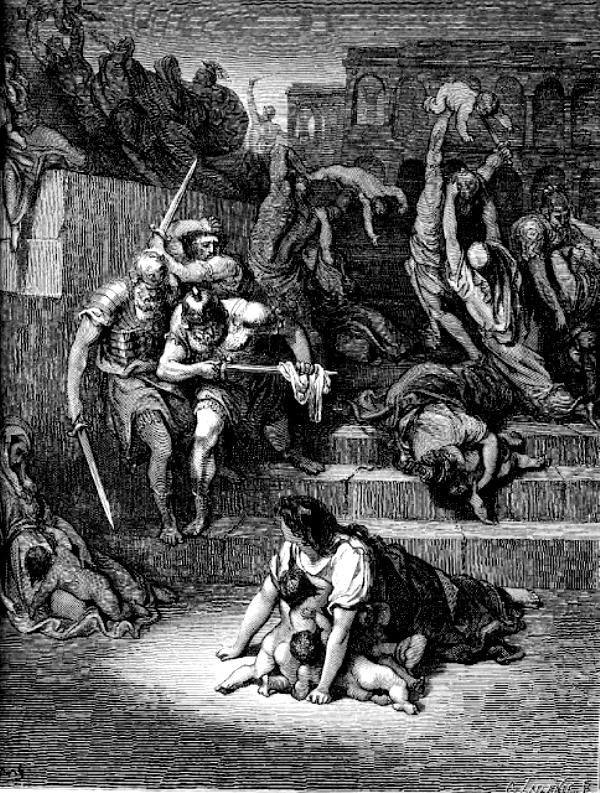
Dec. 28, The Massacre of the Holy Innocents:
And when they were departed, behold, the angel of the Lord appeareth to Joseph in a dream, saying, Arise, and take the young child and his mother, and flee into Egypt, and be thou there until I bring thee word: for Herod will seek the young child to destroy him. When he arose, he took the young child and his mother by night, and departed into Egypt: And was there until the death of Herod: that it might be fulfilled which was spoken of the Lord by the prophet, saying, Out of Egypt have I called my son. Then Herod, when he saw that he was mocked of the wise men, was exceeding wroth, and sent forth, and slew all the children that were in Bethlehem, and in all the coasts thereof, from two years old and under, according to the time which he had diligently inquired of the wise men. Then was fulfilled that which was spoken by Jeremiah the prophet, saying, In Rama was there a voice heard, lamentation, and weeping, and great mourning, Rachel weeping for her children, and would not be comforted, because they are not. (Matt. 2:13-18 KJV)
The Martyrdom of the Holy Innocents, Gustave Dore
ALMIGHTY God, who out of the mouths of babes and sucklings hast ordained strength, and madest infants to glorify Thee by their deaths; Mortify and kill all vices in us, and so strengthen us by Thy grace, that by the innocency of our lives, and constancy of our faith even unto death, we may glorify Thy holy Name; through Jesus Christ our Lord. Amen.

Monday, December 27, 2021

"The only real and abiding pleasure..."

A quotation from Something Fresh by P.G. Wodehouse:
Among the compensations of advancing age is a wholesome pessimism, which, though it takes the fine edge off of whatever triumphs may come to us, has the admirable effect of preventing Fate from working off on us any of those gold bricks, coins with strings attached, and unhatched chickens, at which ardent youth snatches with such enthusiasm, to its subsequent disappointment. As we emerge from the twenties we grow into a habit of mind that looks askance at Fate bearing gifts. We miss, perhaps, the occasional prize, but we also avoid leaping light-heartedly into traps.

As we grow older and realize more clearly the limitations of human happiness, we come to see that the only real and abiding pleasure in life is to give pleasure to other people.

Sunday, December 26, 2021

Mass murder

On the thirtieth anniversary of the collapse of the Soviet Union, and on the 128th anniversary of the birth of Mao Zedong, an important reminder—some things that should not be forgotten.

In the 20th century the selected governments below, within their own countries, quite apart from war, killed their own subjects in massive numbers:
USSR between 1917 and 1987 — 61,911,000
People’s Republic of China between 1949 and 1987 — 35,326,000
Nazi Germany between 1933 and 1945 — 20,946,000
Nationalist China between 1928 and 1949 — 10,075,000
169 million in total were killed by the government ruling them in the last century. 37.4 million more were killed in wars — some started by these same regimes. The statistics come from R.J. Rummel's Death by Government published in 1994 (revised in 1997). There has been a lot of killing of people by their own governments since then.
China's leadership, today, honors Mao, and is genocidal.

Saturday, December 25, 2021

Friday, December 24, 2021

Joan Didion on "The Alamo"

Joan Didion died yesterday, age 87. For a time in the '50s and '60s she wrote for National Review and they have made some of those writings available as pdfs. From her review of John Wayne's The Alamo (1960):
.... About forty-five minutes into The Alamo, a man appears on that immense Todd-AO horizon. He smiles. He moves his shoulders a little. He says "Les-go" or something like it; who cares what he says? He goes riding through the tall grass down to San Antonio, right off the top of the screen, and you are, if you are like me, lost, lost forever. It is John Wayne. It might be Clark Gable. appearing in a white linen suit amid the flaming ruin of Atlanta to carry Scarlett home to Tara; it might be the purr of an American plane—always distinguishable from Axis planes, which had engines that whined—coming in overhead just as the rations run out in a World War II movie. From then on, the ball game's over. At least it was for me. I wept as Wayne told his Mexican inamorata How A Man's Gotta Live. I wept as he explained why Republic Is A Beautiful Word. I wept throughout the siege of the mission; there was no use in my companion's trying to amuse me by pointing out that it had just come home to Richard Widmark, although the problem had been under discussion on screen for some three hours, that "WE NEED MORE MEN!"

I was inconsolable by the time the battle was done, and Wayne lay on the cold cold ground, bleeding as no one has bled since Janet Leigh in Psycho. The last white woman walked out of the Alamo then. She had soot on her face, and she was carrying her child, and she held her head high as she walked past Santa Anna into the sunset. So conspicuous was my sniffling by then that you could scarcely hear the snickers from my neighbors, a couple of young men from Esquire, both of whom resembled Arthur M. Schlesinger Jr.

They don't make 'em like Duke on the New Frontiers.
Joan Didion, “Wayne at the Alamo” — December 31, 1960 (pdf)

Two Christmas prayers

From The Book of Common Prayer, a prayer for Christmas Day:
ALMIGHTY God, who hast given us Thy only-begotten Son to take our nature upon him, and as at this time to be born of a pure virgin; Grant that we being regenerate, and made Thy children by adoption and grace, may daily be renewed by Thy Holy Spirit; through the same our Lord Jesus Christ, who liveth and reigneth with Thee and the same Spirit ever, one God, world without end.  Amen.
And from The Book of Common Worship (Presbyterian Board of Publication), 1906:
O ALMIGHTY God, who by the birth of Thy Holy One into the world didst give Thy true light to dawn upon our darkness; Grant that as Thou hast given us to believe in the mystery of His incarnation, and hast made us partakers of the divine nature, so in the world to come we may ever abide with Him, in the glory of His kingdom; through the same Jesus Christ our Lord. Amen.